Every recruiting conversation gets to the same question eventually, usually in the car on the way home from a showcase: what is college softball actually going to cost us? Most families answer it by looking up the sticker price, and the sticker price is the wrong number for anyone who gets financial aid.
So I pulled the federal cost data from the June 2026 College Scorecard release for every NCAA school that plays softball, 970 of them with complete numbers, out of the database behind Pioneer Pennant Process. Two things jumped out. The median school's net price after aid is about half of its own sticker price. And whether a school is public or private moves the price more than whether it plays D1, D2, or D3.
What does college softball cost after aid, by division?
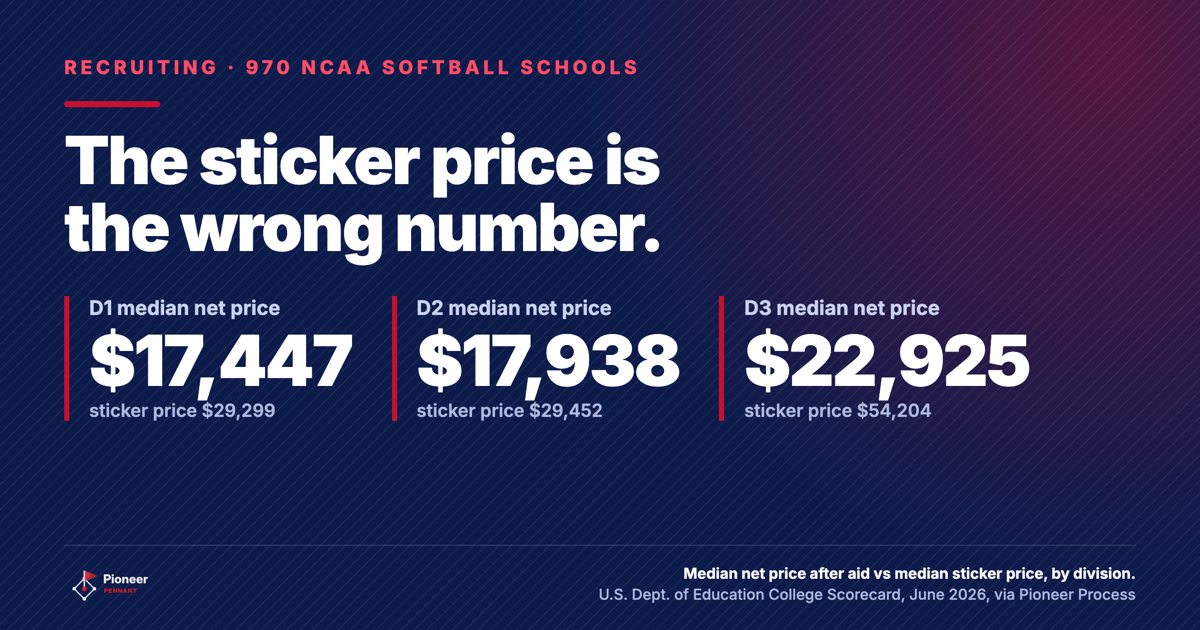
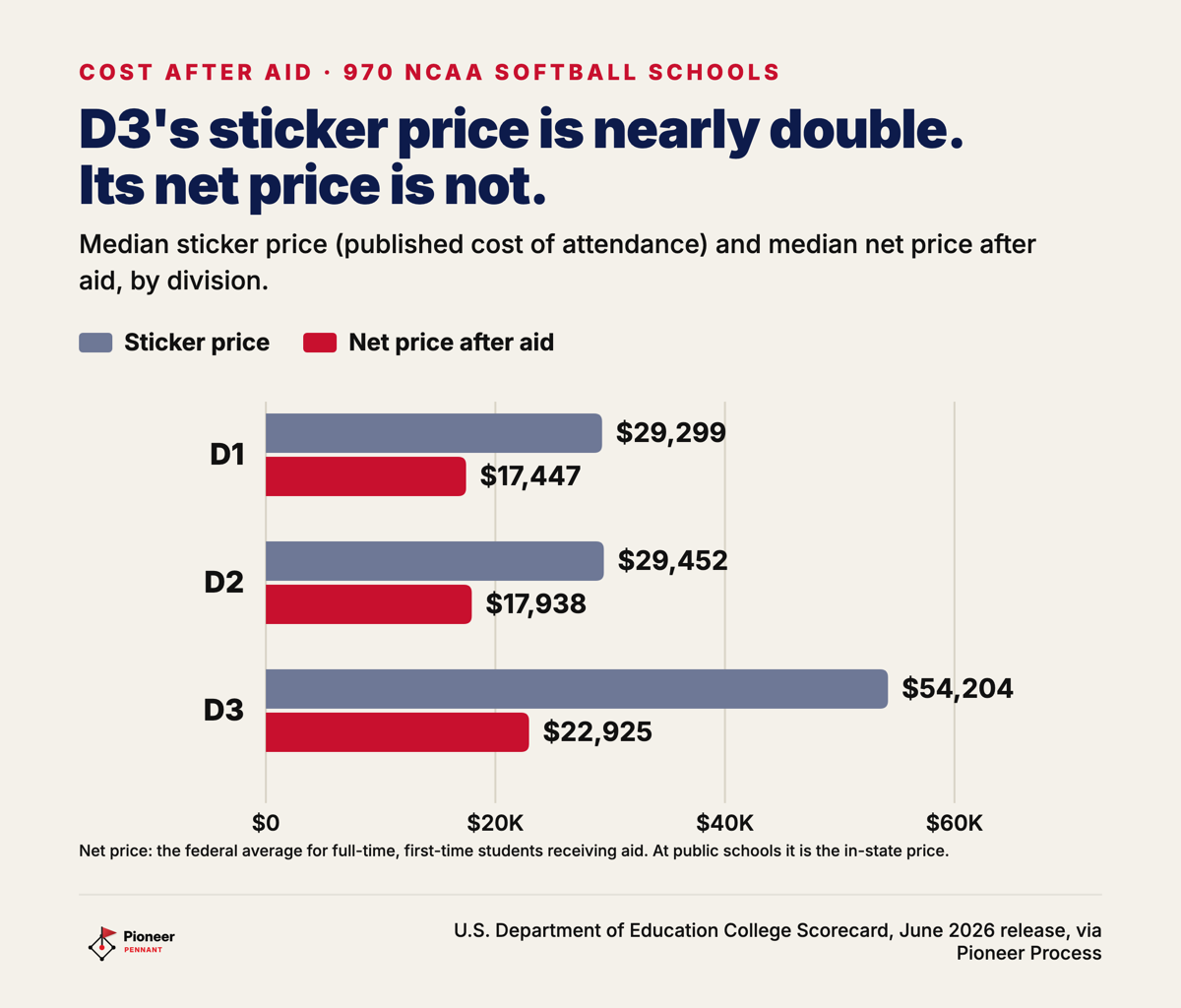
The median net price after aid for an NCAA softball school is $17,447 a year in Division I, $17,938 in Division II, and $22,925 in Division III, against median sticker prices (the school's published cost of attendance) of $29,299, $29,452, and $54,204. The data covers 307 D1, 272 D2, and 391 D3 softball schools.
| Division | Sticker, median | Net after aid, median | Share paid, median school |
|---|---|---|---|
| D1 | $29,299 | $17,447 | 54% |
| D2 | $29,452 | $17,938 | 53% |
| D3 | $54,204 | $22,925 | 45% |
The median D3 sticker price is nearly twice the D1 median, but the median D3 net price is only about $5,500 higher. Division III schools discount the most: at the median D3 softball school, the net price is 45% of the sticker price.
Why is the sticker price the wrong number?
The sticker price is the wrong number because the average student receiving aid at the median softball school pays about half of it. The U.S. Department of Education's College Scorecard calculates net price as tuition, fees, books, supplies, and average living costs, minus the average grant and scholarship aid, averaged over full-time, first-time students who receive federal financial aid.
Two limits of the federal net price matter for a softball family:
- Net price is a school-wide average for students who receive aid, not a softball number, so any one family's figure will differ.
- At a public school, the Scorecard's net price covers in-state students only.
Public or private moves the price more than the division does
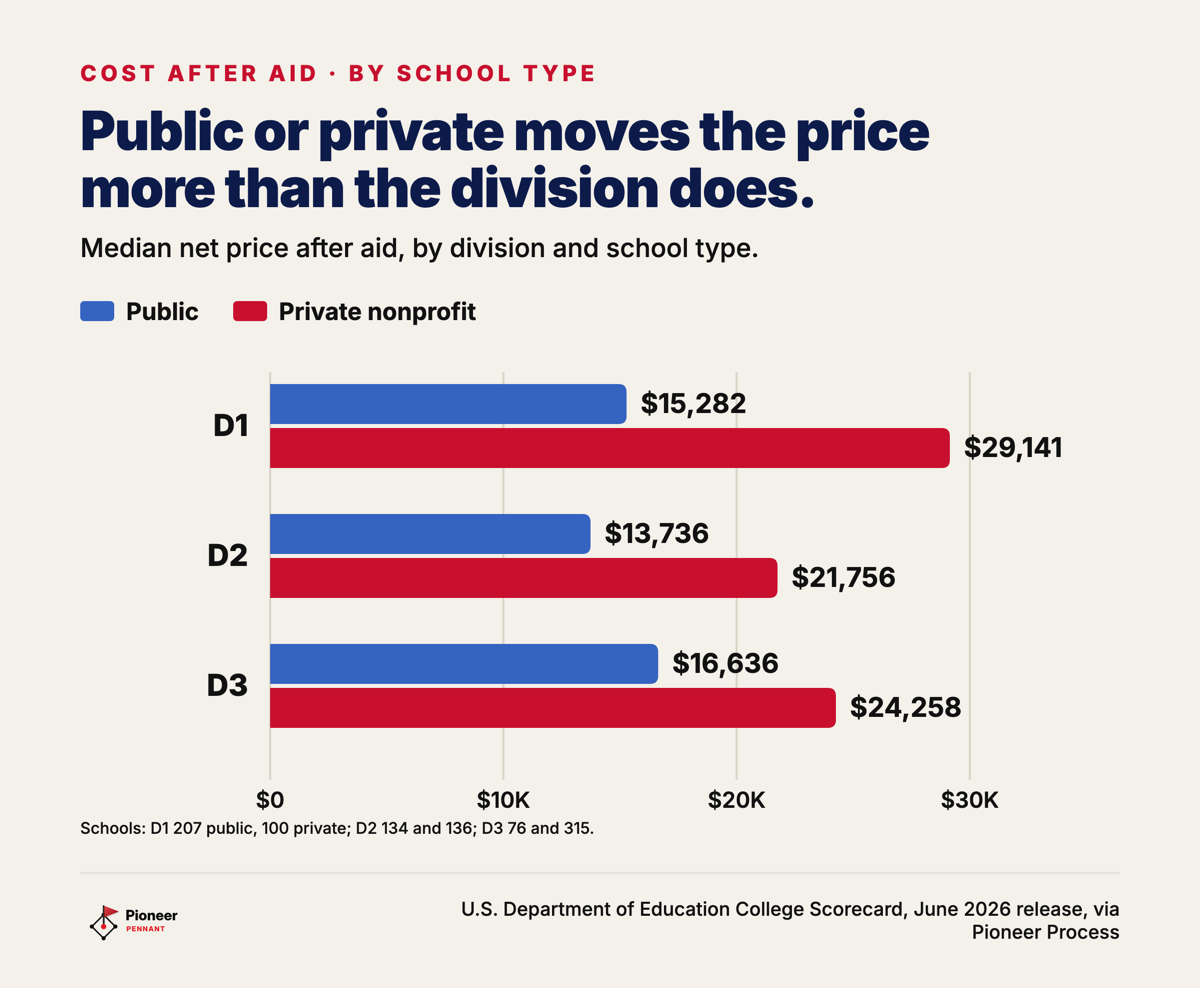
At every level of NCAA softball, the median private school's net price is $7,600 to $13,900 a year higher than the median public school's. The spread between divisions is smaller: the median public-school net price only ranges from $13,736 in D2 to $16,636 in D3.
| Division | Public, median net price | Private nonprofit, median net price | Gap |
|---|---|---|---|
| D1 | $15,282 (207 schools) | $29,141 (100 schools) | $13,859 |
| D2 | $13,736 (134 schools) | $21,756 (136 schools) | $8,020 |
| D3 | $16,636 (76 schools) | $24,258 (315 schools) | $7,622 |
The public-private split explains why Division III looks expensive in the division medians: 315 of the 391 D3 softball schools in the data are private. Compared private to private, D3 comes out cheaper than D1. Of the 315 private D3 softball schools, 246 have a lower net price than the median private D1 school's $29,141.
Division III gives no athletic money and can still cost less
A private D3 school can cost less than a private D1 school without a dollar of athletic money, because private D3 schools discount heavily through academic and need-based aid. Per the NCAA, Division III schools do not offer athletics scholarships, and many D3 athletes receive merit-based or need-based aid. Private D3 softball schools have a median sticker price of $57,799 and a median net price of $24,258, more than half off before a coach says a word.
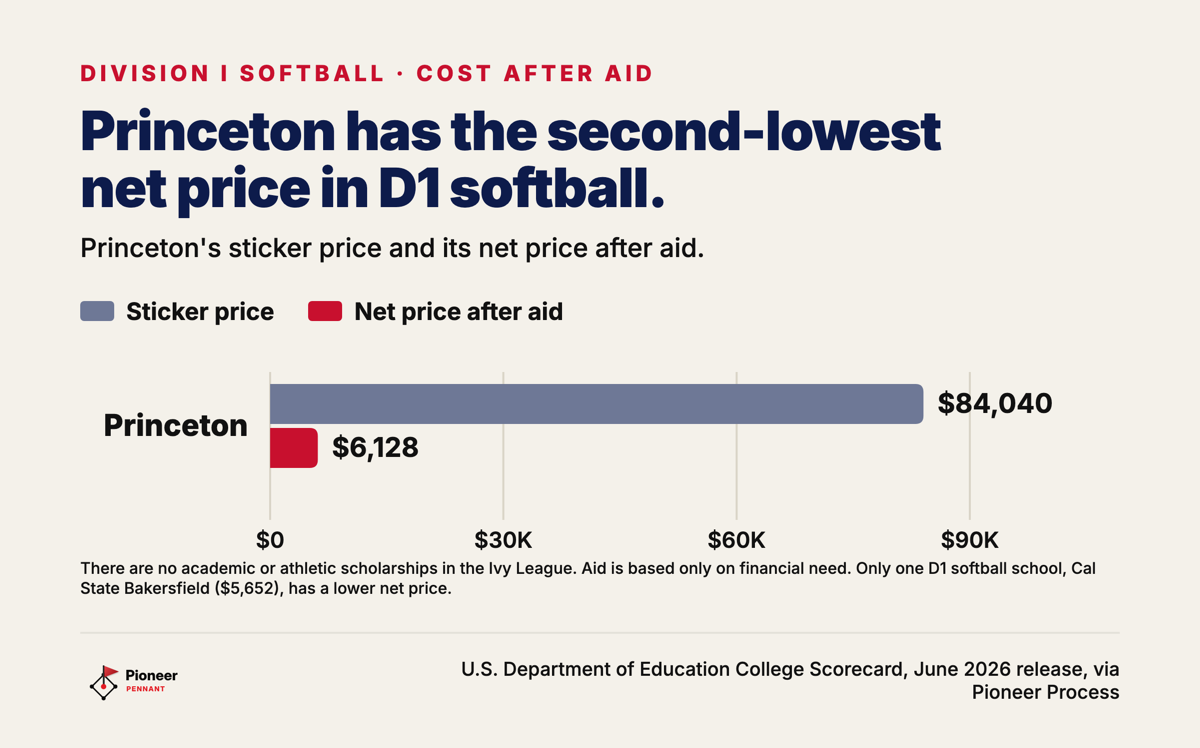
The most extreme example of need-based aid is in Division I. Of the 307 D1 softball schools with federal cost data, Princeton has the second-lowest net price: $6,128 a year against a sticker price of $84,040. The Ivy League gives no academic or athletic scholarships at all, and its aid is based only on financial need. The only D1 softball school with a lower net price than Princeton is Cal State Bakersfield, at $5,652.
What do athletic scholarships change at each level?
Athletic scholarships lower the price for the players who get them, and how much a school can give depends on the division:
- Division I: For D1 schools in the House settlement, NCAA rules since July 1, 2025 replace sport-by-sport scholarship limits with roster limits, and those schools may offer scholarships to any or all of the athletes on the roster. The softball roster limit is 25 under NCAA Bylaw 17.2. How many of those 25 spots a program actually funds is the school's call.
- Division II: A softball program can award up to 7.2 scholarship equivalencies (7.2 full scholarships' worth of athletic aid), and the NCAA's equivalency rules let coaches split that aid across the roster as partial scholarships.
- Division III: No athletic scholarships. The aid package is academic and need-based.
The federal net price is an average across each school's aided students, so treat it as the starting line. The same school can land very differently for two players once athletic money and academic aid are stacked.
The out-of-state catch at public schools
A public school's federal net price is its in-state price. At the median D1 public softball school, out-of-state tuition runs $13,800 a year more than in-state tuition.
Median out-of-state tuition premium at a D1 public: $13,800.
Median net price at a D1 private: $29,141.
On paper, the median in-state net price plus the median out-of-state premium comes to about $29,000, roughly the median private D1 school's net price. Aid for out-of-state students can close some of that gap, and each school's net price calculator will say how much.
How to get your own number
The fastest way to your family's real number is the school's own calculator, then a side-by-side comparison of net prices:
- Run each school's net price calculator. Every school in the federal student aid programs has been required to post one since 2011, under the Higher Education Opportunity Act. The calculator returns an estimate based on your family's own circumstances, which beats any median.
- Compare net prices, never sticker prices. A sticker price twice as high can still come out cheaper after aid, as Princeton shows.
- Ask how the pieces stack. For a D1 or D2 offer, ask the financial aid office how the athletic money combines with academic and need-based aid in your player's package.
- Start with fit, then price. Pioneer Pennant Process covers all 978 NCAA softball schools, with cost after aid next to academics, majors, and coaches, and its "Will it pay off?" calculator puts a school's net price against what the degree typically earns.
One rule applies to money as much as to softball: go where you are going to play, not as high as you can go.
Method, briefly: cost data from the U.S. Department of Education's College Scorecard (institution file, June 10, 2026 release), joined to the NCAA softball-sponsoring schools in Pioneer Pennant Process. 970 schools have a cost of attendance, an average net price, and a confirmed federal match. Medians throughout; the public-private comparison covers public and private nonprofit schools (two for-profit D2 schools are left out of it). Every number computed from the database is re-checked by code against the data before the page builds. When a number here and the data disagree, the page refuses to publish.
Figuring out where your player fits in college?
Pioneer Pennant Process covers all 978 NCAA softball schools: coaches and how to reach them, cost after aid, majors, and a fit score built on one rule. Go where you are going to play, not as high as you can go.