Somebody in the bleachers will tell you that a softball player cannot do nursing, or engineering, or anything with a lab, because the sport eats the schedule. Nobody in the bleachers has a count. So I went and read the rosters.
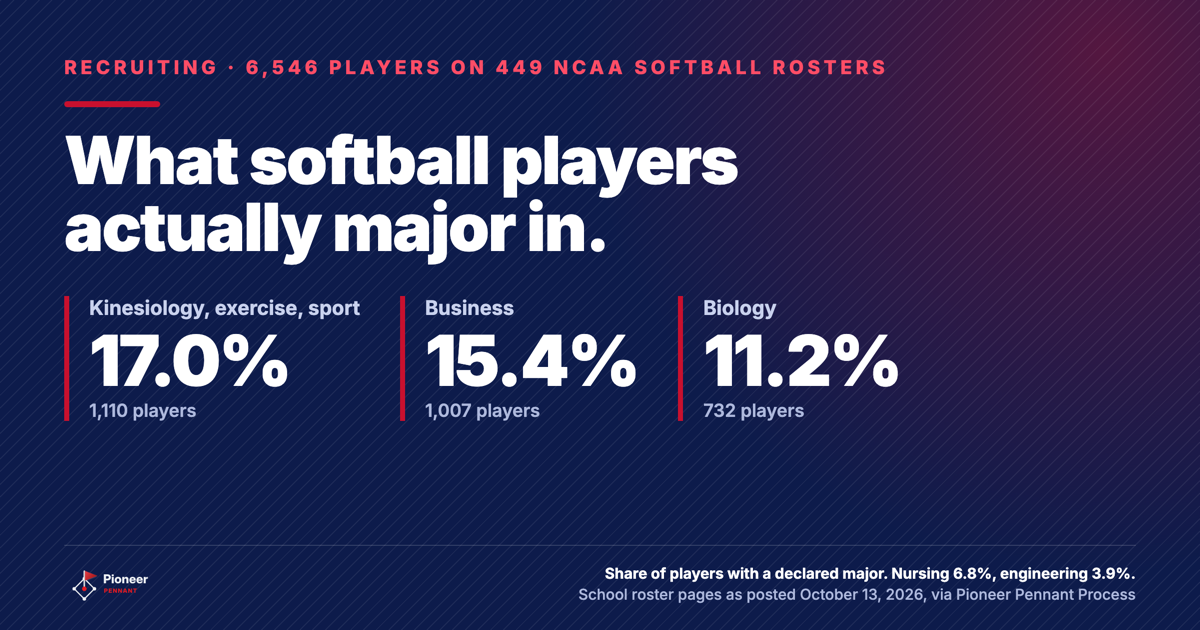
College softball majors start with kinesiology and business. On the 449 NCAA softball rosters in Divisions I, II and III that listed a declared major for at least one player on October 13, 2026, kinesiology, exercise science and sport management led at 17.0% of 6,546 players, then business at 15.4% and biology at 11.2%. Nursing was 6.8% and engineering 3.9%.
The schools come from Pioneer Pennant Process, which already tracks the majors each NCAA softball school confers. This post adds what the players on those rosters say they are studying.
What do college softball players major in?
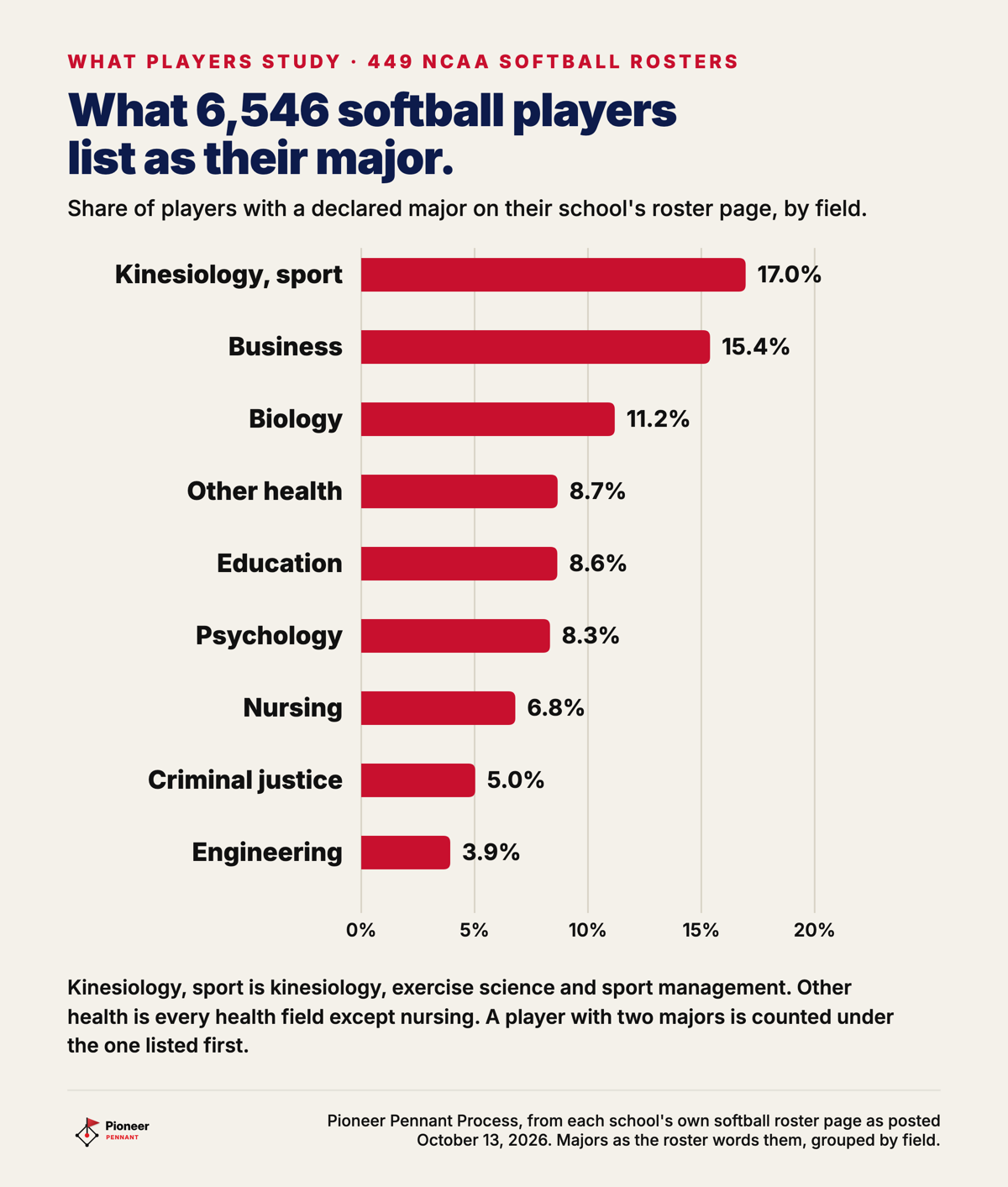
On the rosters that list a major, college softball players most often major in kinesiology, exercise science or sport management, then business, then biology, and those three cover 43.5% of the 6,546 players with a declared major on 449 NCAA rosters. Nursing ranks seventh and engineering ninth. Declared means the roster lists a major and the entry is not "undeclared" or "exploratory"; the 300 players listed that way are left out of every share.
17.0% kinesiology, exercise science or sport management
15.4% business, 11.2% biology, 6.8% nursing, 3.9% engineering
| Field | Players | Share |
|---|---|---|
| Kinesiology, exercise science, sport management | 1,110 | 17.0% |
| Business | 1,007 | 15.4% |
| Biology and biomedical sciences | 732 | 11.2% |
| Health fields other than nursing | 567 | 8.7% |
| Education | 566 | 8.6% |
| Psychology | 545 | 8.3% |
| Nursing | 445 | 6.8% |
| Criminal justice and criminology | 329 | 5.0% |
| Engineering | 257 | 3.9% |
| Social sciences | 250 | 3.8% |
| Communications and media | 217 | 3.3% |
| Everything else | 521 | 8.0% |
The groups are mine, so here is the count with no grouping at all. The major listed most often, taken exactly as the roster words it, is Psychology, on 449 players. Nursing is second on 423, then Biology on 400, Exercise Science on 324, Kinesiology on 235 and Criminal Justice on 208. The 6,546 players list 1,458 different majors as their schools word them, capitalization aside.
The top group is two kinds of major. Of the 1,110 players in the kinesiology, exercise science and sport group, 236 list sport management or another sport business major, and the other 874 are mostly exercise science and kinesiology.
Do softball players pick different majors than their classmates?
Softball players list kinesiology, exercise science or sport management more than four times as often as their own schools award degrees in that field: 17.0% of players with a declared major, against 3.9% of the bachelor's degrees those same schools conferred. Biology and education also run high on the rosters, and computing and mathematics run low.
| Field | Players | Their schools' graduates |
|---|---|---|
| Kinesiology, exercise science, sport | 17.0% | 3.9% |
| Biology and biomedical sciences | 11.2% | 6.7% |
| Education | 8.6% | 5.8% |
| Psychology | 8.3% | 7.3% |
| Criminal justice | 5.0% | 3.8% |
| Nursing | 6.8% | 8.5% |
| Business | 15.4% | 17.9% |
| Engineering | 3.9% | 4.5% |
| Computing and mathematics | 1.6% | 5.4% |
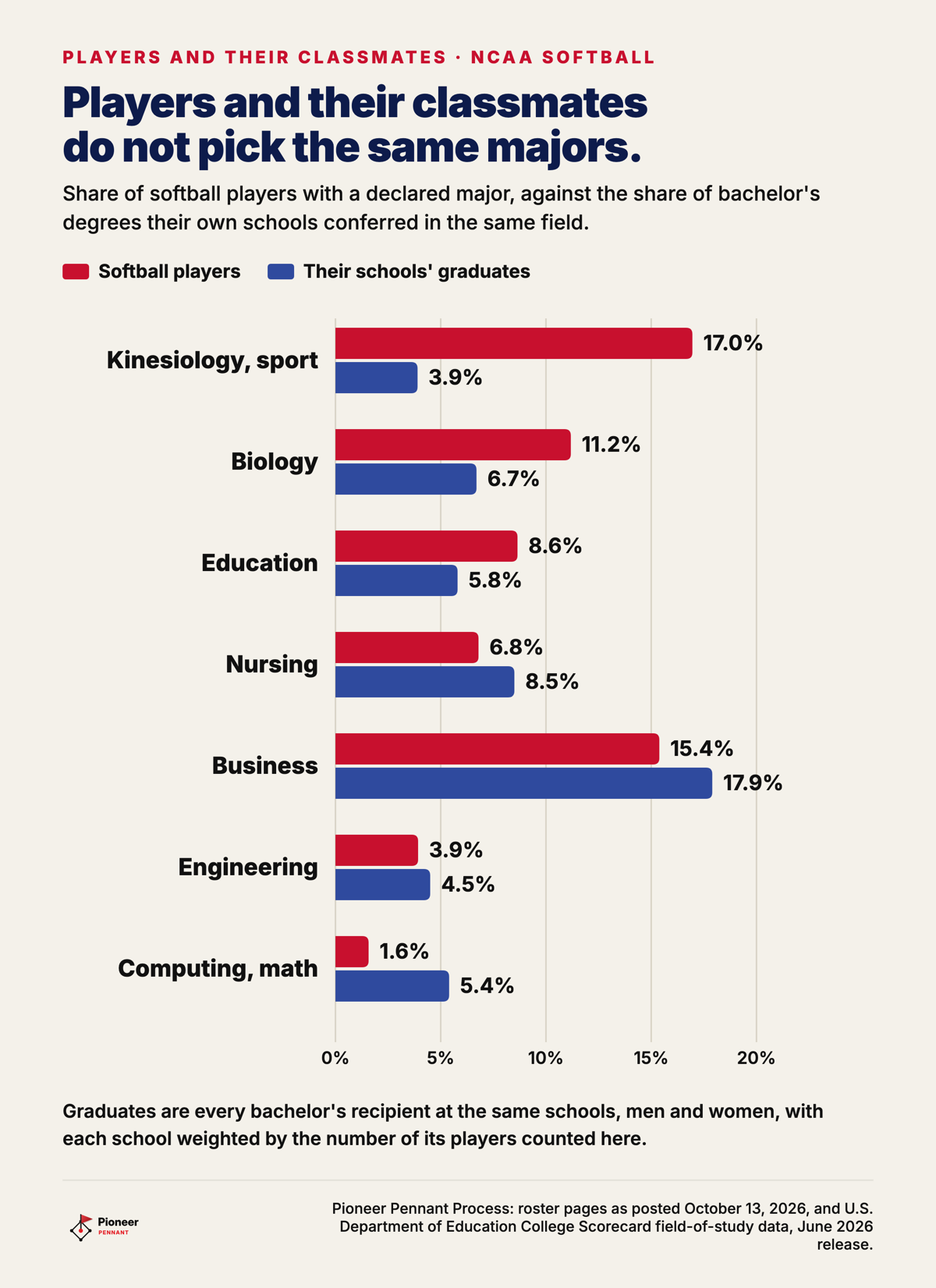
Each school is compared with itself. For every roster in the count I took the share of that school's bachelor's degrees in the matching federal field, from the Department of Education's College Scorecard, and weighted each school by the number of its players counted, so one large campus does not swamp the small ones.
Three cautions go with the comparison. The graduates are everybody, men and women, because the degree counts in Process are not split by sex, and a softball roster is all women. A roster is current students, freshmen included, and the federal counts are finished degrees. And a roster words a major the school's way while the federal file sorts degrees into its own fields, so the edges of a group do not line up exactly: 114 of the 1,110 players in the kinesiology group are at schools with no degrees on file in that federal field.
Do college softball majors change by division?
College softball majors change with the division: kinesiology and business shrink from Division I to Division III, and education and nursing grow. Education is 4.8% of Division I players with a declared major and 10.7% in Division III, and nursing goes from 3.3% to 8.3%.
| Share of players listing it | D1 | D2 | D3 |
|---|---|---|---|
| Kinesiology, exercise science, sport | 21.5% | 18.3% | 13.8% |
| Business | 18.5% | 17.0% | 12.7% |
| Biology and biomedical sciences | 10.0% | 10.5% | 12.2% |
| Health fields other than nursing | 11.9% | 7.9% | 7.6% |
| Education | 4.8% | 8.4% | 10.7% |
| Psychology | 6.3% | 9.0% | 8.8% |
| Nursing | 3.3% | 7.0% | 8.3% |
| Criminal justice | 3.6% | 5.6% | 5.3% |
| Engineering | 4.0% | 4.9% | 3.2% |
The division shares rest on 1,467 players with a declared major on 128 Division I rosters, 2,079 players on 131 Division II rosters and 3,000 players on 190 Division III rosters. Communications is the other major that belongs to Division I, at 5.5% of its players against 2.6% in Division II and 2.7% in Division III.
Can you study nursing and play college softball?
Yes, and players do: 445 of the 6,546 softball players with a declared major on the 449 rosters counted list nursing, which is 6.8%. At the 209 schools that confer a bachelor's degree in nursing and list a declared major for at least ten softball players, 144 have a nursing major on the roster, about seven in ten.
For nursing, the division is the surprise. Counting only schools that confer the degree, nursing is 4.1% of Division I softball players with a declared major (44 of 1,073), 9.2% in Division II (139 of 1,518) and 14.8% in Division III (239 of 1,612).
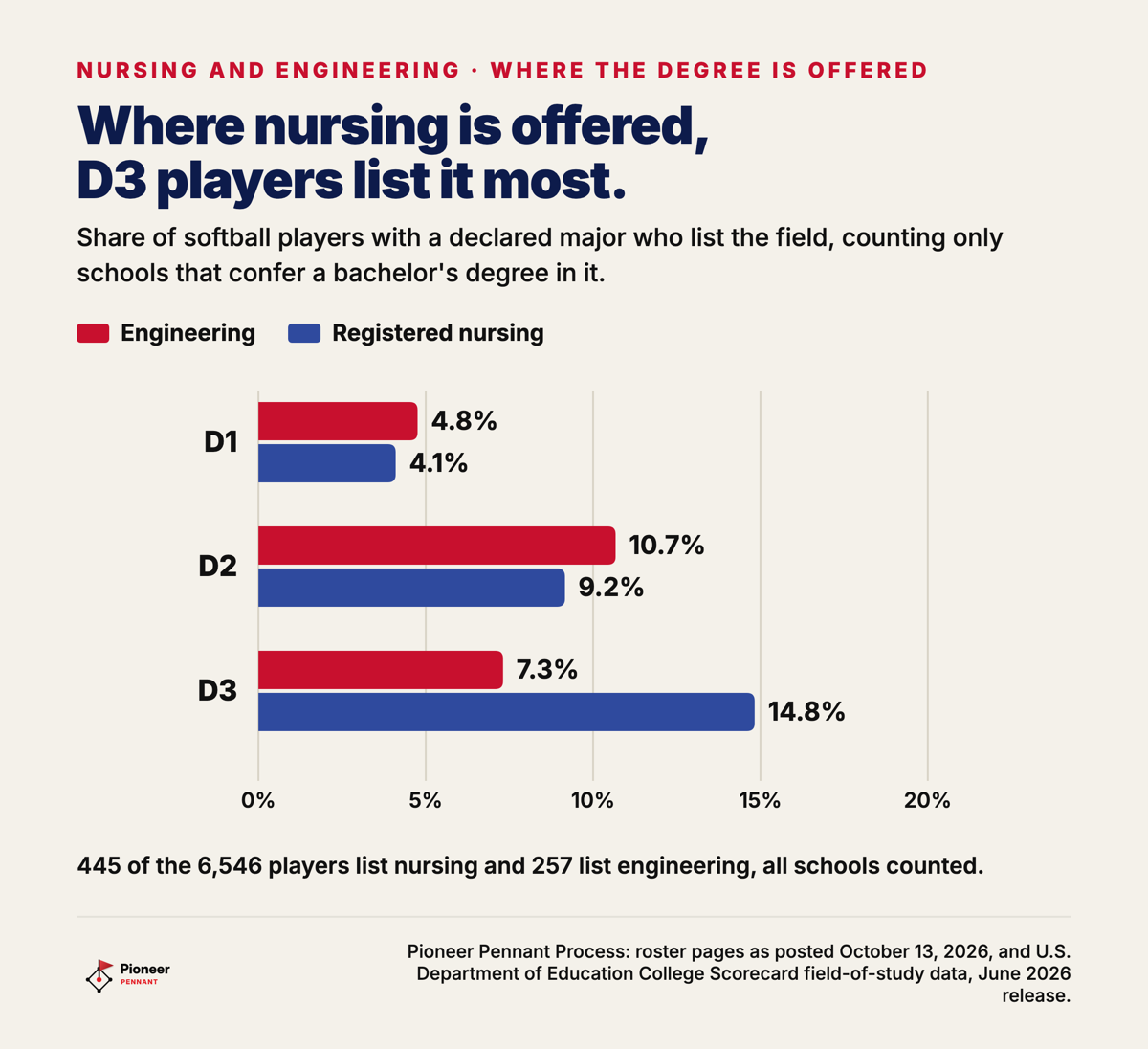
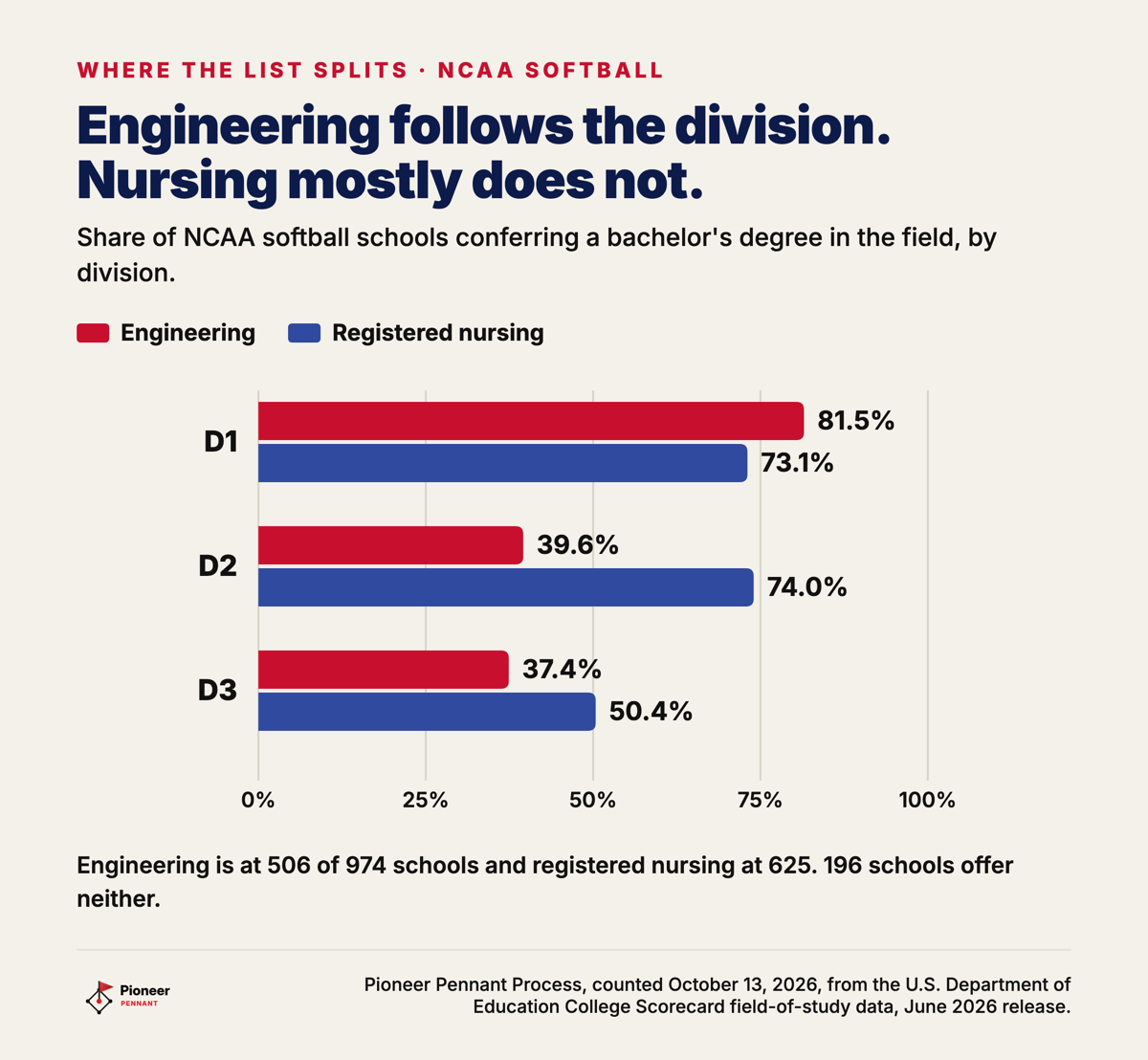
Division III is also the division least likely to offer nursing in the first place. Registered nursing is offered at 50.4% of Division III softball schools, against 73.1% of Division I and 74.0% of Division II, and where a Division III school does offer it, its softball players list it more than three times as often as Division I players do.
One more cut belongs here, and it does not flatter the answer. Nursing is 10.1% of the freshmen with a declared major on these rosters (144 of 1,430), 7.1% of the sophomores, 5.3% of the juniors and 5.2% of the seniors (77 of 1,475). A roster is one day's picture of four different classes, so the drop from freshmen to seniors is not proof that players leave nursing, but it is what a roster would look like if some did.
The rosters do not say why any of this is so, and I am not going to guess. They do say where the nursing majors are playing.
Can you study engineering and play college softball?
Yes: 257 of the 6,546 softball players with a declared major on the 449 rosters counted list engineering, which is 3.9%. Engineering is 4.5% of the bachelor's degrees those players' schools award to men and women combined. Mechanical Engineering is the one listed most, on 78 players, and Civil Engineering is next on 37.
The catch with engineering is the catalog. A bachelor's degree in some field of engineering is offered at 506 of the 974 NCAA softball schools with bachelor's graduates on file in Process, which is 52%, and the rate is 81.5% in Division I against 39.6% in Division II and 37.4% in Division III.
At the 162 schools that confer engineering and list a declared major for at least ten softball players, 75 have an engineering major on the roster, a little under half. Where the degree is offered, engineering is 4.8% of Division I softball players with a declared major (59 of 1,241), 10.7% in Division II (97 of 909) and 7.3% in Division III (92 of 1,259).
Engineering does not thin out by class the way nursing does. Engineering is 3.9% of the freshmen with a declared major on these rosters, 4.1% of the sophomores, 4.2% of the juniors and 3.3% of the seniors.
Is the major she wants offered at the schools recruiting her?
Most of the majors softball players list are offered at most softball schools: biology at 930 of the 974 NCAA softball schools, business at 931, psychology at 847 and education at 830. The ones to check by name are kinesiology at 649 schools, nursing at 625, criminal justice at 525 and engineering at 506.
| Share of schools offering it | D1 | D2 | D3 |
|---|---|---|---|
| Biology | 98.4% | 96.0% | 92.9% |
| Business, any field | 97.1% | 99.6% | 91.6% |
| Psychology | 87.7% | 90.8% | 83.7% |
| Education, any field | 86.7% | 90.1% | 80.7% |
| Kinesiology and sport | 70.1% | 76.9% | 56.7% |
| Nursing, registered | 73.1% | 74.0% | 50.4% |
| Criminal justice | 55.2% | 71.4% | 40.7% |
| Engineering, any field | 81.5% | 39.6% | 37.4% |
A field counts as offered at a school when the school had at least one bachelor's graduate in it. The College Scorecard sorts every bachelor's program into four-digit fields of the federal Classification of Instructional Programs and reports the credentials each school conferred in a field over two consecutive award years, per its field of study documentation.
The size of the catalog follows the division too. The median NCAA softball school confers bachelor's degrees in 39 fields, and the median is 55.5 fields in Division I, 34 in Division II and 35 in Division III.
The NCAA's rules do not narrow a softball player's choice of major. The Division I pace rule the NCAA calls progress toward degree asks a player to complete 40% of her required degree credit before the start of her third year of enrollment, 60% before her fourth and 80% before her fifth, and the NCAA page that states the rule lists no approved or restricted majors. The school finder in Process takes a major as a filter, so the list can start with the schools that offer hers.
What to do with this before the invitation comes
- Read the roster before the visit. Of the 865 softball roster pages I could read, 392 print majors right on the roster. When the school recruiting her is one of them, the answer to "does anybody here do nursing" is already on the page. When the roster shows nothing, ask the coach what the current players study, and how many of the seniors are still in the major they started in.
- Name the major first and build the school list from it. The schools that offer a major are a shorter list than the schools that play softball, so start there and let the sport be the second filter.
- Check the discipline, not just the field. A federal field is a category, so a school that shows up under engineering may not carry the one your player means. Confirm it in that school's own catalog.
- Remember that a field on the list is not a seat in it. These counts say a school confers the degree and that players on its roster list the major. Whether she is admitted to that program is a separate question, answered by that school's admissions office and not by this data.
- Look at the other divisions before you rule them out. Division III is the largest of the three divisions in the sport, with 393 of the 974 schools counted here, and it is where nursing majors are the largest share of the roster. Division I, II or III has the rest of the comparison.
Somebody in the bleachers will keep saying it cannot be done. There are 77 seniors on these rosters listing nursing and 48 listing engineering who were apparently not told.
Method, briefly: the roster half of this post reads each NCAA softball school's own roster page once, as the school had it posted on October 13, 2026, and some pages were still headed as the 2026 season's team. Of the 976 schools in Pioneer Pennant Process, 865 pages were read and 450 carry a major for at least one player: 392 print it on the roster, and 58, all but one of them in Division I, hold it in the roster data the page loads without printing it in the default view. Each site's robots.txt file was honored. A player counts when her roster lists a major, and the 300 whose entry is undeclared, exploratory or a college with no major named are left out of every share, which leaves 6,546 players on 449 rosters. A blank is not counted as anything. Majors are grouped by keyword from the roster's own wording. A player with two majors counts under the one listed first, except that an engineering or teaching major counts as that wherever it sits in the entry, and a "pre" entry counts under the field it names, so 14 pre-nursing entries are in nursing. The kinesiology group also holds physical education, athletic training and sports medicine. The 88 entries no group holds sit in "everything else," and 20 of them are one engineering school's program abbreviations, which I did not decode. A listed major is not a finished degree, and these are the rosters that list a major, not a random sample of every player in the sport. No player is named here or stored by name. The comparison with classmates uses bachelor's degrees by federal field (U.S. Department of Education College Scorecard field-of-study data, June 2026 release, Classification of Instructional Programs codes), each school weighted by its counted players, and it leaves out the health fields other than nursing, where a roster's wording (pre-medicine, pre-physical therapy) and the federal fields match too loosely to compare. The catalog half counts a field as offered at a school when the file shows at least one bachelor's graduate in it across the two most recent award years it holds. Two schools matched to the wrong federal record are left out of every count, leaving 976, and 974 of those have bachelor's graduates on file. Four federal records are shared by eleven softball schools (consolidated universities), so one catalog is counted once for each of its softball members. "Median" means the middle school, not the average. Every number in this post was re-checked by code against the data before the post went out. Process keeps filling in records and schools keep updating rosters, so the counts are as of October 13, 2026. NAIA and junior college schools answer to different governing bodies and are not covered.
Figuring out where your player fits in college?
Pioneer Pennant Process covers all 978 NCAA softball schools: coaches and how to reach them, cost after aid, majors, and a fit score built on one rule. Go where you are going to play, not as high as you can go.