Somebody in the bleachers has told you how many scholarships a college softball team gets. They said it with total confidence. For Division I, that number stopped being the rule in 2025.
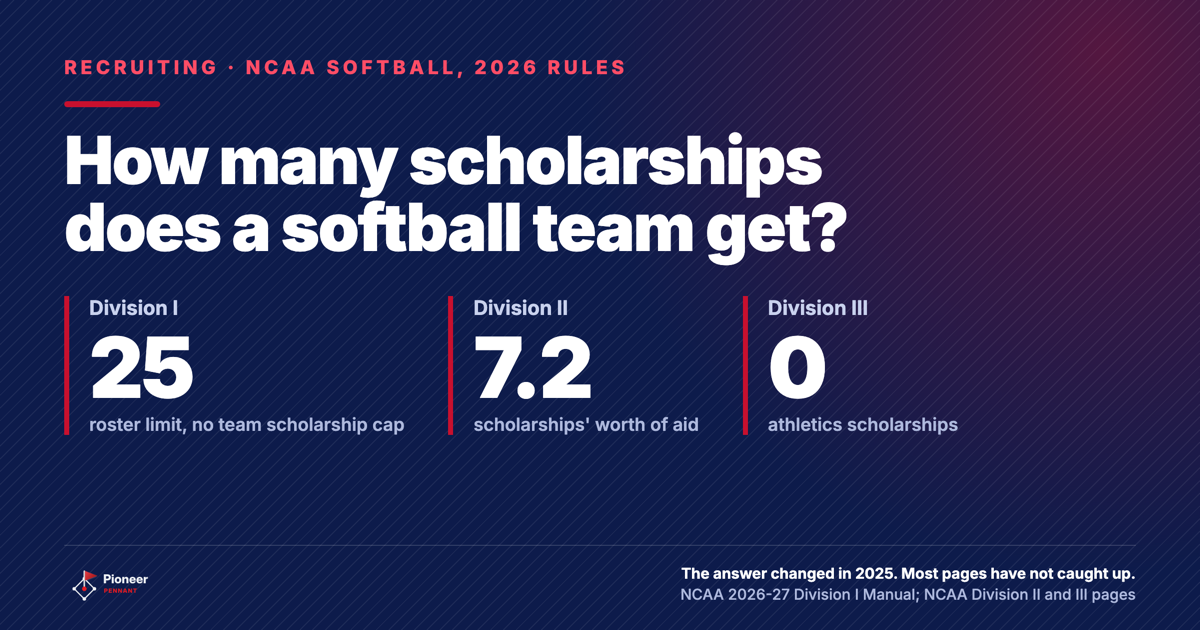
Here is the 2026 answer. A Division II softball team can award aid worth 7.2 full scholarships. A Division III team can award none. A Division I team has no NCAA limit on scholarships at the schools covered by the new roster limit of 25 players. The number that decides your family's bill is the one in the coach's offer, so this post also does the math on what a partial award is worth at a median Division II school, using the database behind Pioneer Pennant Process.
25 players on a Division I softball roster, with no NCAA team scholarship limit under the roster-limit rules.
0 athletics scholarships in Division III.
Division I softball teams have no NCAA scholarship limit at schools under the roster limit
A Division I softball team's limit is its roster, not its scholarships, at every school that is in a defendant conference or opted in to the House settlement. The House settlement is the court-approved class-action settlement that changed how Division I schools pay athletes. The NCAA's Division I manual for 2026-27 lists 25 as the softball roster limit in Bylaw 17.2, adopted June 6, 2025 and effective July 1, 2025, and says the limit applies to "each sport of a Division I institution that is a member of a defendant conference or opts in to the House settlement." The text is in the NCAA Division I Manual.
The scholarship side moved with it. When the Division I Board of Directors adopted the roster limits on June 23, 2025, the NCAA wrote that rules for Division I programs "will no longer include sport-specific scholarship limits", with the changes effective July 1. Any softball scholarship count written before that summer describes a rule that has since been replaced.
The 2026-27 manual does not print a softball team scholarship limit anywhere. It does mention the old one once, in Bylaw 16.13.1.5, which says "there is no limit on the number of new athletics scholarships that may be awarded consistent with the roster limit for a particular sport." The same bylaw counts the cost of attendance value of up to $2.5 million in scholarships above a school's 2024-25 team limit against the school's benefits cap. In plain English, the practical ceiling for a Division I team is what its school chooses to spend, and the NCAA no longer sets the softball number.
The roster limit of 25 squeezes few programs. Process holds the published 2026 roster for 308 Division I softball programs, 6,638 players in all, an average of 21.6 per team. Only 18 of those 308 rosters list more than 25 players. A typical Division I program has room on its roster, so the open question for a family is how much of that roster the school pays for.
The manual says nothing about how a Division I school that did not opt in handles a softball team's aid, so that is a question for the coach and the school's compliance office.
A Division II softball team shares 7.2 full scholarships
A Division II softball team can award athletics aid worth 7.2 full scholarships in a year. The NCAA's Division II athletics scholarships page lists softball at 7.2 and calls these equivalency limits, the "maximum number of athletics scholarships that may be awarded across an entire team." Coaches often split that amount among several players rather than giving full scholarships to each, and the NCAA's own definition of a partial scholarship is "a portion of college expenses covered through athletics aid."
Seven point two sounds like a lot until you divide it by the roster. Process holds the published 2026 roster for 253 Division II programs with 5,469 players, an average of 21.6 per team. Share 7.2 scholarships across 21.6 players and each player's piece is 0.333, one third of a full scholarship. No coach splits it evenly, but it is the number to hold in your head when someone says Division II softball is "all scholarships."
Division III softball teams have no athletics scholarships
A Division III school cannot give an athlete a scholarship for playing softball. The NCAA states it twice on its Division III eligibility page: "Division III schools do not offer athletics scholarships, but merit-based and need-based aid may be available."
That second clause is the whole recruiting conversation at a Division III school. Money comes from the admissions and financial aid offices, based on grades or family finances, not from the coach. The aid is large at many of them, because 315 of the 391 Division III softball schools with federal cost data are private nonprofits. The median Division III softball school lists a cost of attendance of $54,204 and a median net price after aid of $22,925, across all 391 Division III schools with federal cost data. Net price is the federal Scorecard's average over first-time, full-time students who receive federal aid, so it is a starting line and not a quote for your family.
What a one-third scholarship is worth depends on the school's price
A partial scholarship is a share of the school's price, so the same share is worth very different dollars at a public school and at a private one. To show it I took the one-third share from the roster math and applied it to the median Division II school's published cost of attendance. This is an illustration of the arithmetic. A coach may offer a dollar amount that looks nothing like it.
| Median Division II school | Cost of attendance | A third off | Left to pay |
|---|---|---|---|
| Public (134 schools) | $23,637 | $7,879 | $15,758 |
| Private nonprofit (136 schools) | $48,420 | $16,140 | $32,280 |
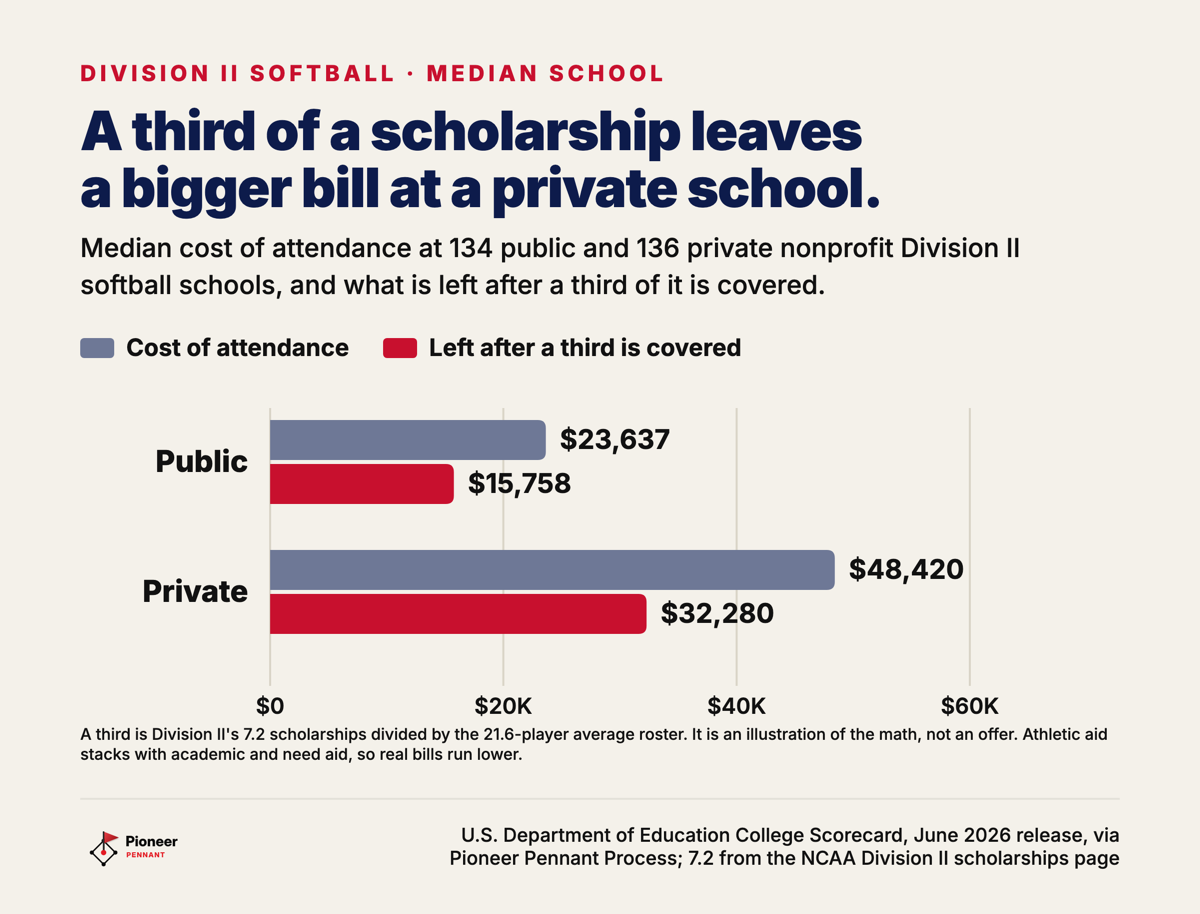
A third of a scholarship at the median private nonprofit Division II school still leaves $32,280, more than the entire sticker price of the median public Division II school at $23,637. A third of a scholarship is a bigger gift at the private school and a smaller bill at the public one, which is why the sticker price has to be on the table before the award is.
Athletic money does not arrive alone. Most schools stack it with academic and need-based aid, and the real bill is usually lower than the "left to pay" column. The cost-after-aid breakdown shows what families at these schools pay on average once everything is counted, and the Process calculator runs the numbers for one family.
What the Division I rulebook says about the offer itself
Whatever the team number is, the Division I manual protects the offer in three ways that a family can ask about. These are Division I rules, so ask a Division II school's compliance office for its version.
- It is in writing, from financial aid. An award for an academic year must come with a written statement of the amount, duration, conditions and terms, and the signature of the financial aid office. The athletic director's signature does not satisfy the rule (Bylaw 15.3.2.2).
- It lasts at least a year. Aid that counts athletics ability in any degree cannot be awarded for less than one academic year or for longer than the student's five-year period of eligibility (Bylaw 15.3.3.1).
- An injury does not end it. Aid cannot be conditioned on the athlete reporting in satisfactory physical condition, and the school stays committed to the original award even if an injury prevents her from playing (Bylaw 15.3.2.1).
Those are the questions to ask a coach: what is the dollar amount, how many years does the paperwork cover, and who signs it. A family that has the answers in writing is comparing offers. A family that has a number from the bleachers is guessing.
If you are still deciding where she belongs, Pioneer Pennant Process puts the cost, the roster and the coach contact for every NCAA softball school on one page. Go where she is going to play, not as high as she can go.
Method, briefly: NCAA rules from the 2026-27 NCAA Division I Manual (Bylaws 15.3.2.1, 15.3.2.2, 15.3.3.1, 16.13.1.5 and 17.2, read October 20, 2026), the NCAA's June 23, 2025 Division I Board release, the Division II athletics scholarships page and the Division III eligibility page. Roster counts are the 2026 published rosters in Pioneer Pennant Process; cost figures are from the U.S. Department of Education College Scorecard (institution file, June 10, 2026 release), joined to the NCAA softball schools in Process. Two schools matched to the wrong Scorecard record are left out. All Process counts are dated counts as of October 20, 2026, and every number computed from the database was re-checked against it before the post went out. The one-third share is the Division II limit of 7.2 divided by the average roster, applied to each group's median cost of attendance as an illustration, not as what any coach offers.
Figuring out where your player fits in college?
Pioneer Pennant Process covers all 978 NCAA softball schools: coaches and how to reach them, cost after aid, majors, and a fit score built on one rule. Go where you are going to play, not as high as you can go.