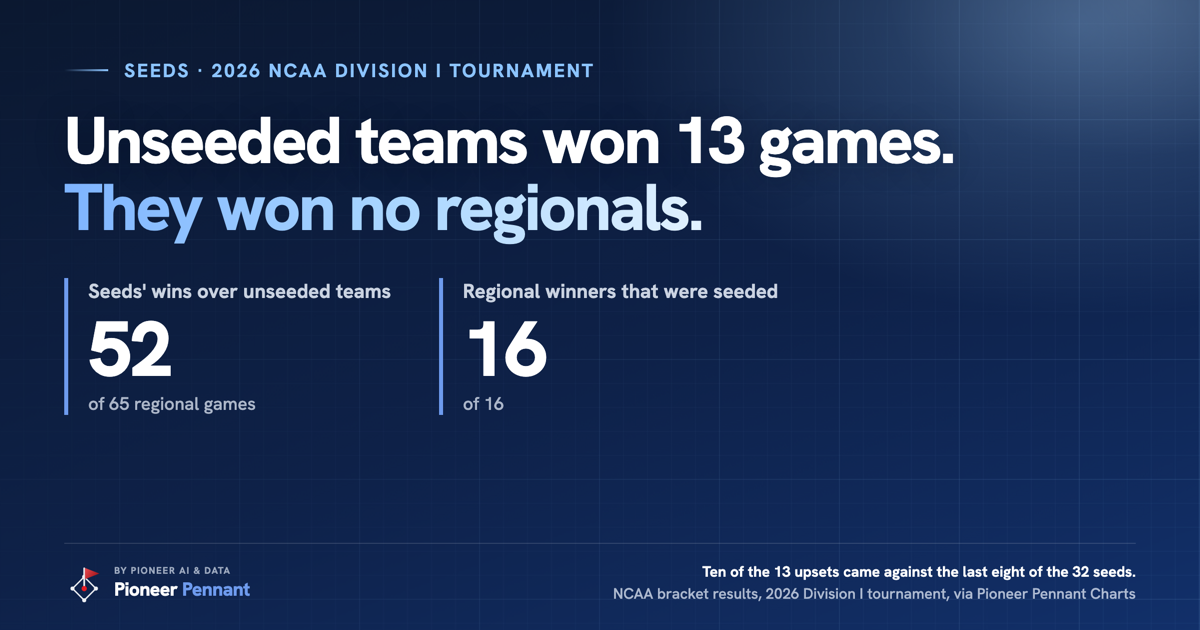
Every May somebody in the parking lot says seeds are a suggestion and anybody can win a regional. The 2026 NCAA Division I softball tournament was the first to seed 32 teams, and its results say the opposite: seeded teams won 52 of their 65 regional games against unseeded teams, and all 16 regional winners were seeded.
Unseeded teams did land punches. They beat seeded teams 13 times. But a regional is a four-team, double-elimination tournament, and not one of those 13 wins turned into a regional title.
Unseeded teams won 13, and 0 of 16 regionals.
The top 24 seeds went 44-3 against unseeded teams. The last eight seeds went 8-10.
Every team's 2026 season, game by game, is on Pioneer Pennant Charts.
What is a seed in the 2026 NCAA softball tournament?
A seed is one of the top 32 spots in the 64-team field, and 2026 was the first year the NCAA seeded that many. According to NCAA.com, the top 32 teams were "seeded nationally in pods of four," and the top 16 seeds were given the chance to host a regional. The other 32 teams got no seed.
The pods set the matchups. The NCAA paired the pods within the bracket "ones paired with eights, twos paired with sevens, threes paired with sixes and fours paired with fives," so each four-team regional had two seeded teams and two unseeded ones. Alabama, Texas, Oklahoma and Nebraska were the top four seeds.
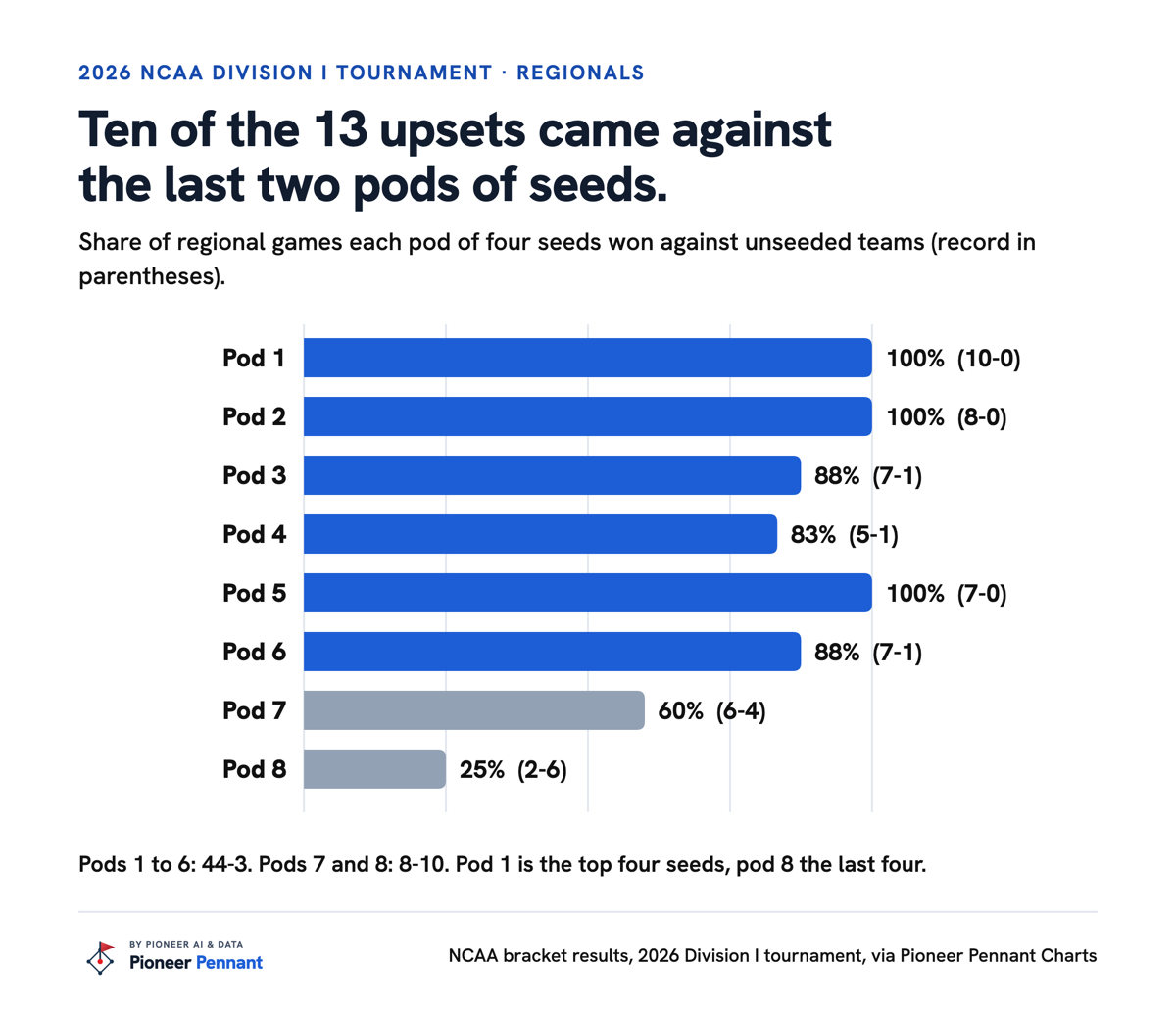
This post uses the pod number from the NCAA's bracket data, 1 through 8. Pod 1 is the top four seeds, and pod 8 is the last four of the 32. Pods 1 through 4 are the 16 teams that could host.
How often did unseeded teams beat seeded teams in the 2026 regionals?
Unseeded teams beat seeded teams 13 times in 65 regional games between the two, so seeded teams won 80.0% of them. Nine different seeds lost to an unseeded team, and four of them lost twice: Southeastern Louisiana, Louisville, Washington and Texas State.
Nine of the 13 upsets were decided by two runs or fewer. Softball games are short and close, and one result proves little.
The regionals also had 21 games between two seeded teams and 12 between two unseeded teams. Those games cannot be an upset by this count, so they are left out of the 65.
Which seeds lost to unseeded teams?
The last two pods did, mostly. Seeds in pods 1 through 6, the top 24, went 44-3 against unseeded teams, a 93.6% win rate. Seeds in pods 7 and 8, the last eight, went 8-10, a 44.4% win rate, and 10 of the 13 upsets came against them.
Pod 8 had the worst of it, at 2-6. Those four teams were the last of the 32 seeds, and the NCAA paired them with the top four. The chart above shows every pod. The top eight seeds, pods 1 and 2, never lost to an unseeded team.
The three other seeds that lost to an unseeded team were all from the middle of the field: one each from pods 3, 4 and 6.
Did any unseeded team win a regional?
No. All 16 teams that reached a super regional were seeded, which means every regional winner came from the top 32. None of the nine seeds that lost to an unseeded team won its regional, and neither did any of the unseeded teams that beat them.
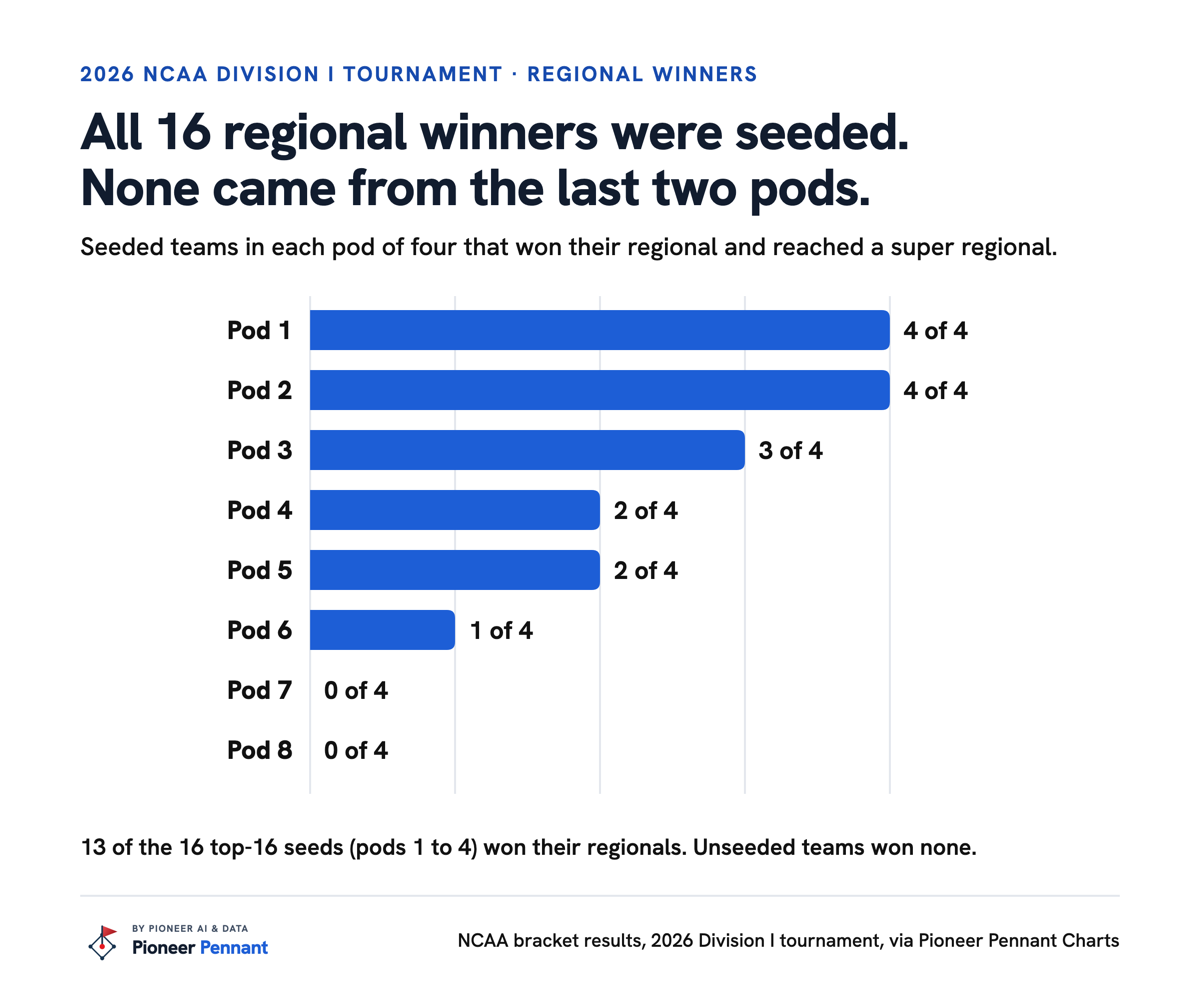
The regional winners ran in line with the pods. Pods 1 and 2 won all eight of theirs, pod 3 won three, pods 4 and 5 won two each, pod 6 won one, and pods 7 and 8 won none.
Seeds did not hold everywhere. Thirteen of the 16 top-16 seeds won their regionals. Florida State, Oregon and Texas A&M did not, and another seeded team won each of their regionals. Mississippi State, a pod 5 seed, then beat Oklahoma, a pod 1 seed, two games to one in the super regional. The Mississippi State season page has the details.
Seven of the eight teams at the Women's College World Series were from pods 1 through 4. What those eight lineups did once they got to Oklahoma City is in the World Series hitting post.
So are seeds a suggestion?
Seeds are a good guide through the top 24 and a rough one after that. The belief is right that a short, close, double-elimination weekend produces upsets: there were 13 of them. It is wrong that they pile up into a title. In 2026 no unseeded team strung enough wins together to take a regional.
Two cautions. This is one tournament and 65 games, so a single pod's record, like pod 8's 2-6, rests on a handful of games. And 2026 was the first year of the 32-team seeding, so this post makes no comparison with earlier years that seeded 16. What it settles is narrower: in the first year of the new format, the unseeded half of the field won games and lost every regional.
Method: every number here was counted from the 133 NCAA tournament games in the Pioneer Pennant Charts warehouse (May 15 to June 4, 2026, Division I) and re-checked before the post went out. A seeded team is one of the NCAA's top 32 seeds, and a pod is the NCAA bracket's label for a group of four of them, 1 through 8. Format details come from NCAA.com, May 11, 2026.
See the whole 2026 season.
Every D1 team, count leverage, spray charts, run expectancy, and the sabermetric rankings behind this post. Free.