Somebody in the bleachers will tell you that an official visit means the school pays for everything and an unofficial visit means you pay for everything. Half right, which in recruiting is usually the expensive half.
An official visit in college softball is any campus trip financed in whole or in part by the school, and what a school may finance changes by division. Division I can fly your player out and buy round-trip tickets for two of you. Division III is forbidden from paying for a parent's travel. Pioneer Pennant Process carries all 976 NCAA softball schools with complete records, and 308 of them play Division I, so the version of the rule most families have heard describes less than a third of the sport.
So I read the visit bylaws in all three of the NCAA's 2026-27 manuals and put the divisions side by side, then measured how far apart the schools actually are. The rulebook gives families more than they expect in one place and shuts a door they did not know was there in another, and the map decides which of the rules you will ever use.
What counts as an official visit in college softball?
An official visit is a campus visit "financed in whole or in part by the member institution," and that same sentence appears in all three manuals: Division I Bylaw 13.02.19.1, Division II 13.02.16, and Division III 13.02.12.1. An unofficial visit is a visit "made at the prospective student-athlete's own expense." The line between an official visit and an unofficial one is money, not ceremony, and nobody has to call a trip official for it to be official.
Division I puts a dollar figure on that line. Under Bylaw 13.02.19.2, expenses or entertainment worth more than $100 make a visit official, outside the short list of things Bylaws 13.5 and 13.7 allow a school to hand a family anyway.
What each division can pay for on an official visit
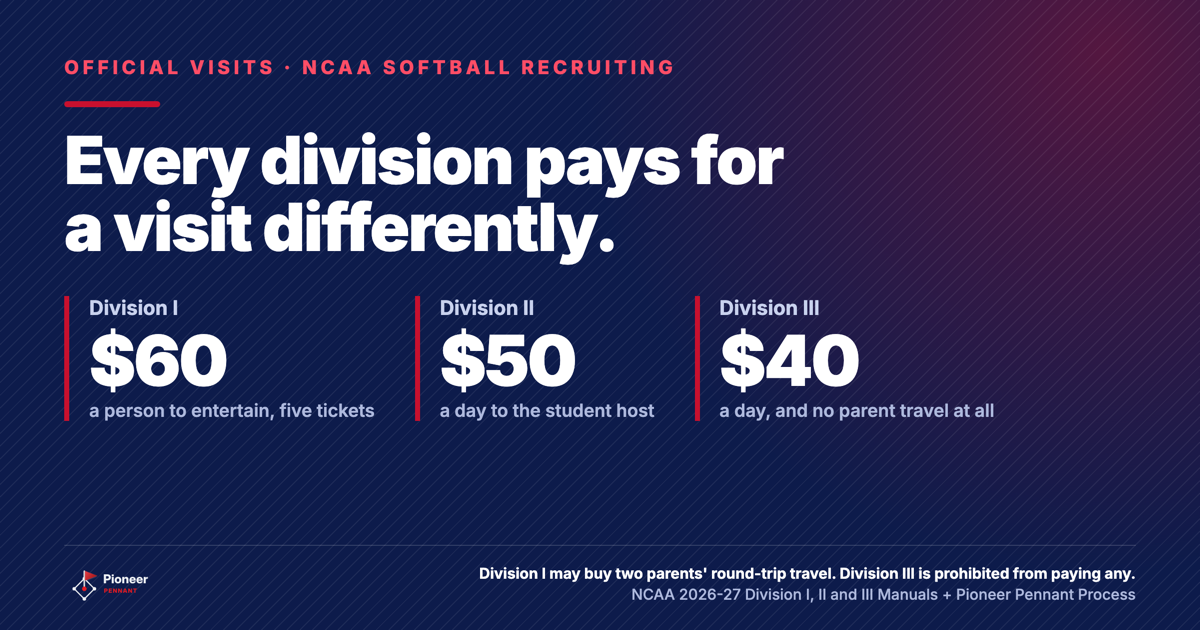
All three divisions may pay for your player's travel, her lodging, her meals, some entertainment and her ticket to a game. Where they split is the parents: Division I may buy round-trip travel for two family members, Division II's bylaw covers only the player, and Division III is barred from paying a parent's travel at all.
| The school may cover | D1 | D2 | D3 |
|---|---|---|---|
| Her travel | Any location | Round trip | Direct route |
| A parent's travel | Two of you | Not in bylaw | Prohibited |
| Lodging | Her plus four | Her and family | Her and parents |
| Meals | Three a day | Actual cost | Three a day |
| Entertainment | $60 a person | $50 a day | $40 a day |
| Game tickets | Five | No number | No number |
The Division I rules are Bylaws 13.5.2.1, 13.5.2.6, 13.6.4, 13.6.6, 13.6.7.2, 13.6.7.4 and 13.6.7.7 of the 2026-27 manual. Division II is Bylaws 13.3.4.1, 13.3.6.2, 13.3.6.3, 13.3.7 and 13.3.8. Division III is Bylaws 13.5.2.1, 13.5.2.8, 13.6.5.2, 13.6.5.5, 13.6.5.6 and 13.6.6.
Two rows in that table get repeated wrong almost everywhere, including in all three synthesized search answers I pulled while writing this. The Division I ticket cap is five, not three (Bylaw 13.6.7.2). Three is the unofficial-visit number, and the two get swapped. The Division I entertainment allowance is $60 per person for your player, her student host and up to four family members, excluding meals and admissions (Bylaw 13.6.7.4), and the money may not be handed over in cash or spent on a T-shirt. A student host is the enrolled student assigned to show her around, either a current player or a student the school uses for campus tours generally (Bylaw 13.6.7.5).
The entertainment figures are not measured the same way, so the three dollar amounts do not compare directly. Division I's $60 is per person for the whole visit. Division II's $50 and Division III's $40 go to the student host for each day of the visit, to cover your player and her family together, with $25 and $20 more per day if the host is showing around a second recruit.
A parent's plane ticket is a Division I benefit and a Division III violation
Division I may pay the actual round-trip cost for up to two family members to come along, under Bylaw 13.5.2.6. Division II's travel bylaw covers your player and stops there: Bylaw 13.3.4.1 lets a school pay "the prospective student-athlete's actual round-trip transportation costs," with no provision for anyone else. Division III says no outright. Bylaw 13.5.2.8 states that a school "shall not permit" its staff or boosters to pay or arrange travel for a recruit's relatives, friends or guardians.
Division III leaves two doors open in that same bylaw. A school may still reimburse mileage to your player even when the whole family rides along, and it may drive family members between campus and the airport once they get there. Division II works the same way on the drive: under Bylaw 13.3.4.2 the school may pay round-trip mileage to whoever actually paid for it, at the rate it pays its own staff.
Even the cabin class is written down. Division II caps commercial air travel at first class or comparable (Bylaw 13.3.4.3). Division III caps it at coach (Bylaw 13.5.2.3). The gap between those two divisions is sitting right there in the travel bylaw.
The unofficial visit is nearly empty in Division I and not in the other two
On an unofficial visit, a Division I school may give your family three tickets and nothing else. Division II may pay for your family's meals. Division III may feed everyone in the campus dining hall and put your player up for the night.
Division I's Bylaw 13.7.3.1 is blunt about it: during an unofficial visit the school "may not pay any expenses or provide any entertainment except a maximum of three complimentary admissions" to a home event, with two more allowed for a nontraditional family under 13.7.3.1.1. Bylaw 13.7.3.1.2 says your player "may pay the actual cost of meals" and eat with the team, which means she is welcome at the table and she is buying.
Division II hands a family more on a trip it paid for itself. Bylaw 13.4.2.1.2 lets the school provide the actual cost of meals for your player and her relatives or guardians, and Bylaw 13.4.3 lets a coach drive her around the facilities and to a home game. Division III goes further still. Bylaw 13.7.2.1.1, revised on January 16, 2026 and effective since August 1, lets the school provide a meal in its on-campus dining facility for your player and the people with her, and Bylaw 13.7.2.1.2 lets the school provide housing during an unofficial visit when that housing is available to every visiting prospective student.
Division II, unofficial visit: the school may pay for the family's meals.
Division III, unofficial visit: a dining hall meal, and a bed if the school houses all visiting students.
All three divisions let her visit at her own expense an unlimited number of times, under Bylaws 13.7.2, 13.4.1 and 13.7.1. The visit with no cap on it is the one you are paying for, and in two divisions out of three it is less unofficial than the name makes it sound.
When can the first official visit happen?
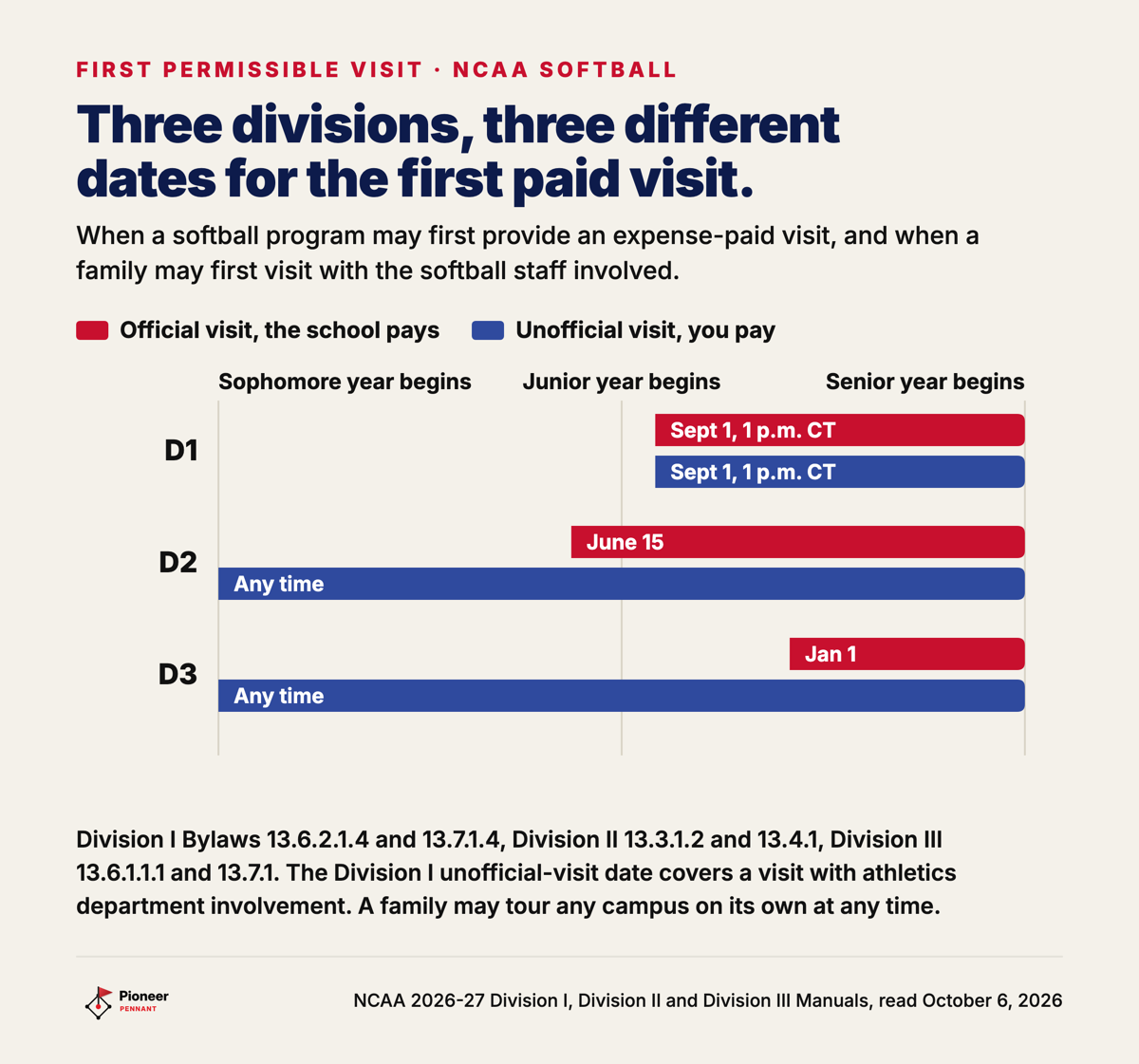
A Division I softball official visit cannot happen before 1 p.m. Central time on September 1 of your player's junior year of high school, under Bylaw 13.6.2.1.4, which was adopted on June 24, 2026 and is recorded in the NCAA's legislative database as Division I Proposal 2026-16, status Adopted Final. Division II opens on June 15 immediately preceding the junior year (Bylaw 13.3.1.2). Division III opens on January 1 of the junior year (Bylaw 13.6.1.1.1).
Division I puts that same moment on the visit you pay for yourself. Under Bylaw 13.7.1.4, an unofficial visit "with athletics department involvement" cannot happen before 1 p.m. Central on September 1 of junior year, so a campus tour run by the softball staff waits with everything else. Division III writes the opposite into its bylaw: 13.7.1 says plainly that a recruit may make unofficial visits before January of her junior year.
The visit dates are one half of a longer timeline. The contact dates that go with them, including what a coach may send and when, are in when college softball coaches can contact you.
How many official visits can one player take?
One per school, and the manuals put no cap on her total. Division I's Bylaw 13.6.2.2 is titled "Number of Official Visits -- Institutional Limitations," and nothing in Bylaw 13.6.2 limits the player. Division II (13.3.1.1) and Division III (13.6.1.1) each allow a school to finance one visit as well.
The one-visit limit resets once she finishes high school, which matters for a transfer or a late recruit: Division I and Division III start a second window on October 15 after high school (13.6.2.2 and 13.6.1.2), and Division II starts on September 1 (13.3.1.3). One exception runs across the divisions: if the head coach who recruited her leaves and a new one is hired, the school may finance one additional visit (Division I 13.6.2.2.1, Division II 13.3.1.1.1).
How long a visit runs is written two different ways. Division I limits the school to two consecutive nights of lodging (13.6.4). Division II and Division III cap the visit at 48 hours, clocked from the minute she arrives on campus (13.3.3 and 13.6.2).
The visits she can reach are mostly in the division that can pay the least
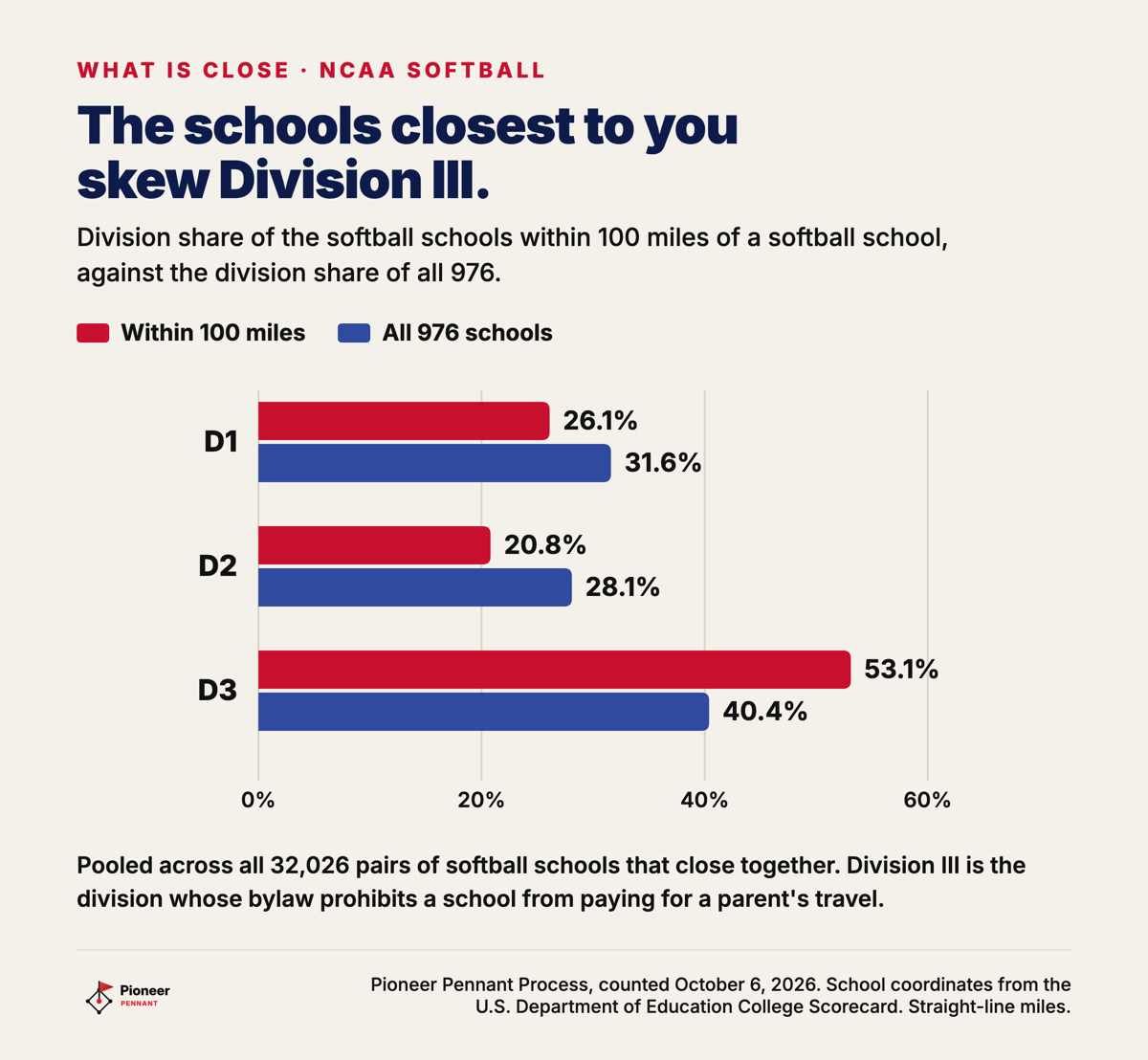
More than half of the softball schools sitting close to any given softball school are Division III, which is the division that is not allowed to pay for the drive. Process holds coordinates for 975 of the 976 schools, and counted on October 6, 2026, the map is tighter than the one families carry in their heads.
901 of the 975 schools on the map have another softball school within 50 miles.
53.1% of the softball schools inside 100 miles of a softball school are Division III, against 40.4% of all 976.
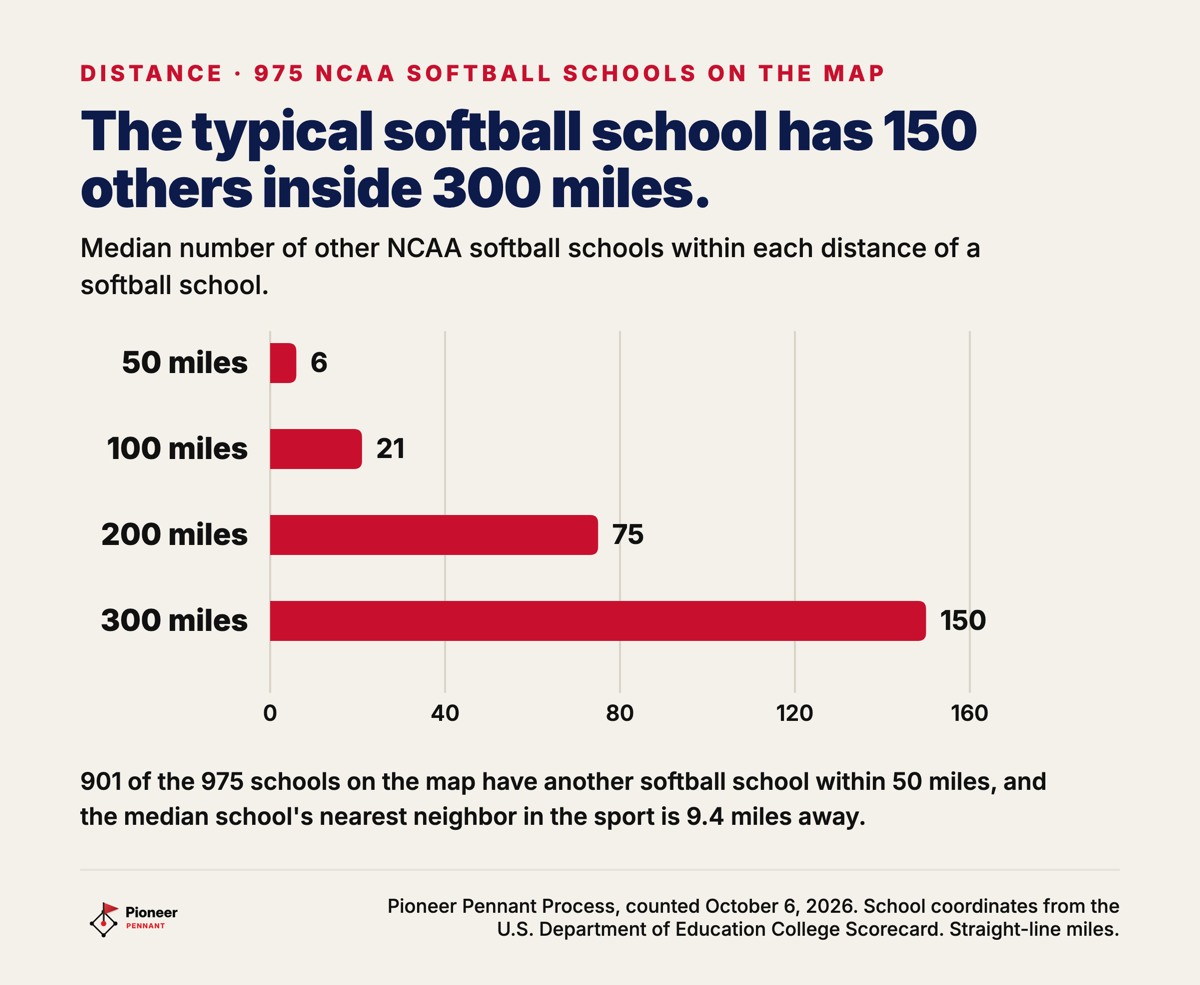
The median school's nearest neighbor in the sport is 9.4 miles away. Within 50 miles the median school has 6 others, within 200 miles it has 75. College softball clusters where colleges cluster, and the Northeast is the densest part of it: Pennsylvania has 91 softball schools and New York has 81, which is more than Texas and California put together. A player willing to look at Division III is looking at a different map than one who is not, and the Process map is the fastest way to see which schools sit inside a weekend.
Put the rules and the map together and the order comes out backward from the way recruiting gets described. The official visits, the ones a school pays for, are capped at one apiece and in Division I cannot start until the fall of junior year. The visits a family will actually take are the drives, and those are the ones where Division II and Division III can at least cover a meal.
What to do before the invitation comes
- Ask what the school is covering, by name. A coach saying "we will take care of the visit" means something different in each division. Travel for two parents, travel for the player only, or travel for nobody but her.
- Do not save the drive for later. Unofficial visits are unlimited in all three divisions and have no Division I date attached unless the softball staff is involved, so a Saturday on campus in tenth grade costs you gas and nothing else.
- Ask a D2 or D3 staff about a meal. The bylaws allow it on a visit you paid for. Most families never ask, because the pages they read said an unofficial visit comes with nothing.
- Count the schools inside a day's drive before you count the ones inside a dream. More than half of what is close to you is Division III, and Division III is the biggest of the three divisions in the sport, 394 of the 976 schools.
A visit is not an offer, and a paid visit is not a bigger offer. A paid visit is a budget line in a rulebook, and the rulebook is different at every level of the sport.
Method, briefly: every rule in this post was read on October 6, 2026 from the NCAA's own 2026-27 Division I, Division II and Division III manuals in the NCAA Legislative Services Database, with the bylaw number given for every rule stated. School counts and distances were computed from the Pioneer Pennant Process database, which carries all 978 NCAA softball schools; two schools matched to the wrong federal record are left out of every count here, leaving 976, and 975 of those carry coordinates. Distances are straight-line great-circle miles between school coordinates from the federal College Scorecard, not driving miles, and a handful of consolidated universities share one federal record, so a few of their campuses sit on the same point (the farthest-apart pair is inside 90 miles). "Median" here means the middle school of the 975, not the average. The Division III share inside 100 miles is pooled across all 32,026 pairs of schools that close together, so a dense corner of the map carries more of it than an empty one. NAIA and junior college schools answer to different governing bodies and are not covered. Every Process number in this post was re-checked by code against the database before the post went out, and Process keeps filling in records, so the counts are as of October 6, 2026.
Figuring out where your player fits in college?
Pioneer Pennant Process covers all 978 NCAA softball schools: coaches and how to reach them, cost after aid, majors, and a fit score built on one rule. Go where you are going to play, not as high as you can go.