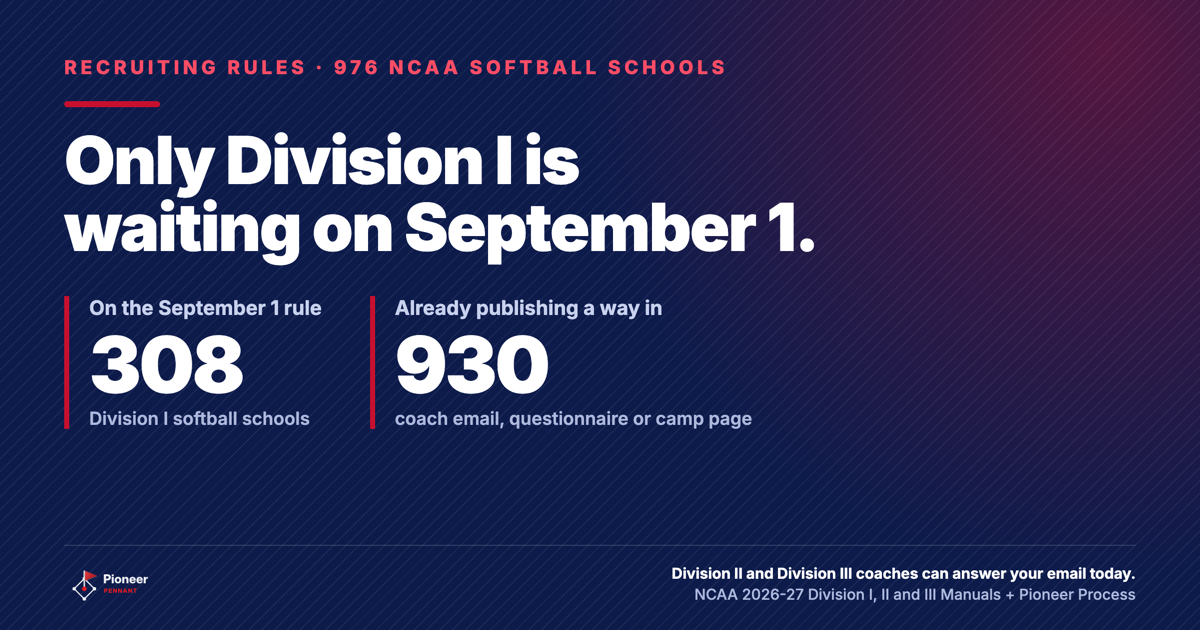
Every softball family with a sophomore has heard the same countdown. Wait until September 1. That is when the coaches can start calling.
The countdown is real. It is also the most misread date in the sport. When college softball coaches can contact you depends entirely on the division, and the rule everybody quotes covers 308 of the 976 NCAA softball schools in the database behind Pioneer Pennant Process. At the other 668, nothing is stopping a coach from writing back this afternoon.
So I went through all three of the NCAA's 2026-27 manuals and pulled the bylaws, then counted what the schools themselves publish on their own sites. The rules are stranger than the advice going around, and the counts say the waiting is mostly self-imposed.
When can college softball coaches contact you?
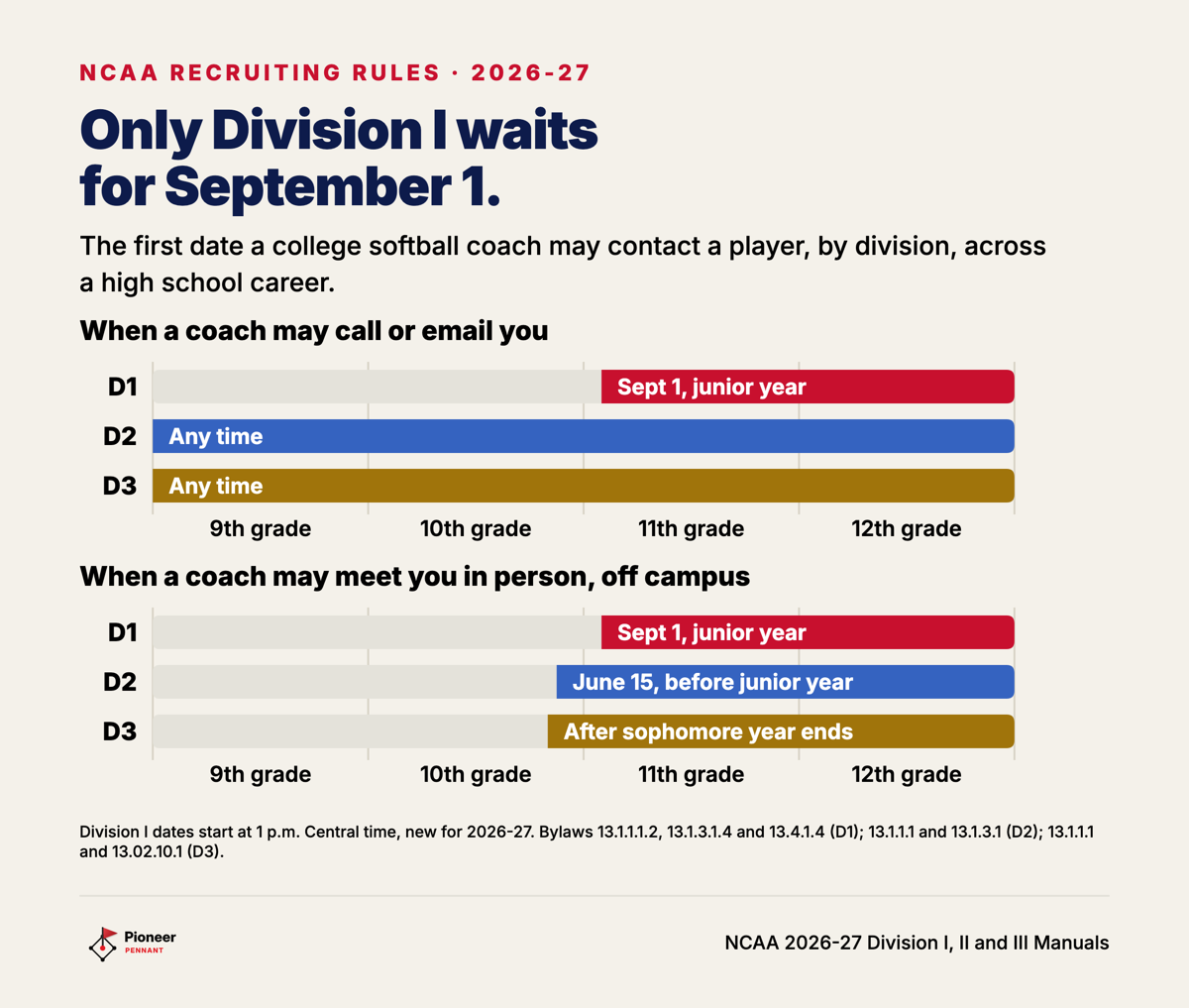
A Division I softball coach may not contact you before September 1 at the beginning of your junior year of high school. Division II opens in-person contact on June 15 before the junior year, and puts no date at all on calls and emails. Division III sets no date on calls or emails at all.
Every date in the table below sits in the same stretch of high school. Division I's September 1 is the opening of junior year, Division II's June 15 is the June before junior year, and Division III's January 1 falls in the middle of it.
| What a coach may do | D1 | D2 | D3 |
|---|---|---|---|
| Call or email you | Sept 1 | Any time | Any time |
| Take your call | Sept 1 | Any time | Any time |
| Meet you off campus | Sept 1 | June 15 | Sophomore year ends |
| Pay for a campus visit | Sept 1 | June 15 | Jan 1 |
Every Division I date now carries a time of day as well, which is the part nobody has caught up to yet.
The D1 dates are NCAA Division I Bylaws 13.1.1.1.2, 13.1.3.1.4, 13.4.1.4 and 13.6.2.1.4 in the 2026-27 manual. The D2 dates are Division II Bylaws 13.1.1.1, 13.1.3.1 and 13.3.1.2. The D3 dates are Division III Bylaws 13.1.1.1, 13.02.10.1 and 13.6.1.1.1.
Softball is stricter than the Division I default. For most D1 sports, off-campus contact opens August 1 of the junior year under Bylaw 13.1.1.1. Softball waits an extra month.
What changed in 2026: the rule now has a clock on it
The September 1 date did not change in 2026, but the moment did. Seven softball bylaws were rewritten on June 24, 2026 to read 1 p.m. Central time September 1 instead of September 1. The rewrite reaches every way a Division I coach can open a conversation: off-campus contact, phone calls, taking a call from you, recruiting materials and electronic correspondence, official visits (the campus trip the school pays for), and unofficial visits where the softball staff is involved.
The NCAA Division I Softball Oversight Committee put the change forward, effective August 1, 2026, and wrote down why. The committee's March 2, 2026 report says a start time will "prohibit midnight calls and initial recruiting contact throughout the night and dawn."
A rule that has to name the middle of the night tells you what September 1 used to look like.
What is a D1 coach allowed to do before that date?
A Division I coach may send you camp information, general school publications, and NCAA material at any time, in any grade. Bylaw 13.4.1.13 lists what a school may hand a recruit, and camp or clinic information carries no date restriction at all.
The camp exception matters more than it sounds. A camp brochure in a ninth grader's inbox is not a coach noticing your player, it is a mailing list, and the rulebook permits that mailing list when it permits almost nothing else.
A coach may also answer an email you send, with limits. Under Bylaw 13.4.1.12, a staff member may reply to a recruit's message before the permissible date as long as the reply carries nothing that would start the recruitment. The examples the bylaw gives are an explanation of NCAA rules or a pointer to the admissions office. So a polite, generic, slightly useless reply in April of sophomore year is a coach following the rule, not a coach passing on your player.
What can your family do before that date?
Almost everything, because Bylaw 13 restricts schools, not families. The one real limit is the phone: a D1 staff member may not take a call from you before 1 p.m. Central on September 1 of junior year, under Bylaw 13.1.3.2.8. Email and questionnaires have no such rule.
Here is the part I went and counted. The advice to reach out early is on every recruiting page on the internet, and not one of them says how many schools actually make it possible, so I counted. Of the 976 NCAA softball schools in Process, 810 publish a softball coach's email address, 607 list a recruiting questionnaire, and 693 list a camp or clinic page.
46 of 976 publish none of them.
308 of 976 are the Division I schools waiting on September 1.
| Door | D1 (308) | D2 (274) | D3 (394) |
|---|---|---|---|
| Coach email published | 288 | 238 | 284 |
| Recruiting questionnaire | 215 | 169 | 223 |
| Camp or clinic page | 263 | 188 | 242 |
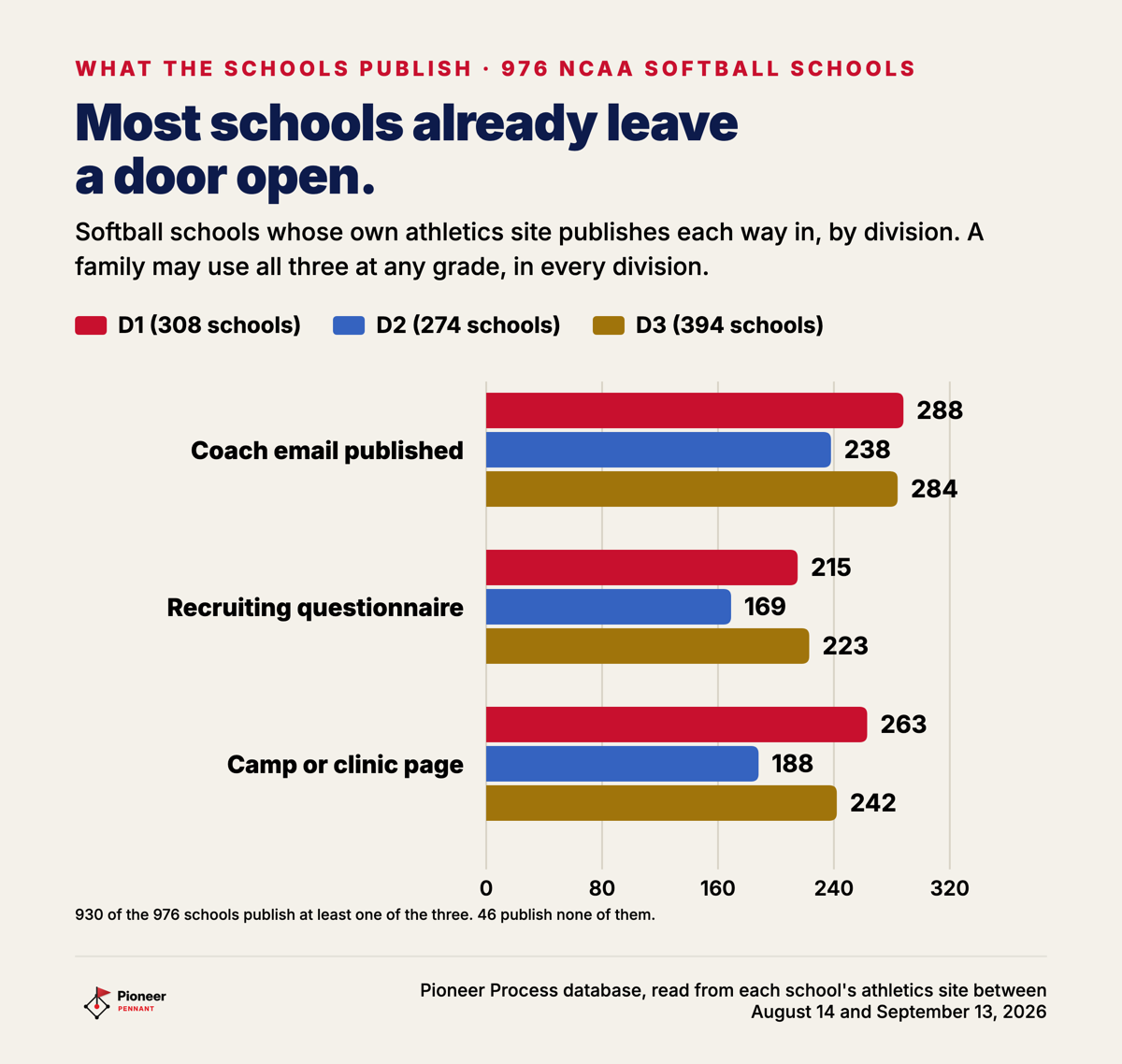
The honest caveat is in the camp column: only 230 of those 693 camp pages go straight to softball. The other 463 land on a general athletics camps hub, so the softball dates take another click to find.
Two thirds of college softball is not Division I
Of the 976 NCAA softball schools, 668 play Division II or Division III, and the September 1 rule does not reach a single one of them. Division II has 274 softball schools and Division III has 394, against 308 in Division I. Process carries a page for each level, including every Division III softball school.
The three levels are governed differently on purpose. Division I runs on recruiting calendars, the contact, evaluation, quiet and dead periods that carve up a coach's year. Division II works off recruiting reminders instead, and Division III uses neither, per the 2026-27 Guide for the College-Bound Student-Athlete.
A D3 coach can answer your email in tenth grade. A D1 coach thirty minutes down the road cannot. Same player, same week, different rulebook.
Which signals actually mean a coach is interested?
The NCAA answers this one directly. Bylaw 13.02.15.1 names exactly what makes your player a recruited prospective student-athlete: a paid official visit, an arranged in-person meeting off campus, a written offer of athletics aid, or a settlement related benefits agreement, the other signed agreement the rulebook lists beside athletics aid.
A camp invitation is not on that list. Neither is a questionnaire confirmation, and neither is a form email. Those are the three things that fill our inbox every spring, and not one of them makes a player recruited. The rule I use, and the one the Process recruiting tracker is built on, is simple: a camp invite is marketing, and a coach typing your player's name is interest.
After September 1, Division I interest comes with a budget attached. Under Bylaw 13.1.5.8, a school gets seven recruiting opportunities per player per year, and no more than three of them may be off-campus contacts. A program spending one of its three on your player has made a decision about her.
What to do with the time you have
The window before the date is the part of the process a family actually controls, and none of it needs a coach's permission.
- Send the email anyway. Nothing in the rulebook stops you, and a D1 coach who cannot reply can still read it and keep the name. Put the class year, position, and a video link in the first three lines.
- Fill out the questionnaire. It is how an athletic department routes a name to the softball staff without anyone breaking a rule, and 607 of the 976 NCAA softball schools publish one.
- Pick camps for the coaching, not the invitation. An invite proves nothing. A camp where your player gets two hours in front of a staff that recruits her level proves something.
- Build the list past Division I. The Process guide walks the steps, and Process carries academics, majors, cost and coaches for all 978 NCAA softball schools. What a school costs after aid moves more than most families expect, which is what college softball costs after aid.
The date is a starting gun for the coaches. It was never a starting gun for you.
Method, briefly: rules read from the NCAA's own 2026-27 Division I, II and III manuals and the 2026-27 Guide for the College-Bound Student-Athlete, with the bylaw number given for every rule stated. School counts computed from the Pioneer Pennant Process database, which carries all 978 NCAA softball schools; two schools matched to the wrong federal record are left out of every count here, leaving 976. A published coach email, questionnaire or camp link means the school's own athletics site listed one when Process last read it, between August 14 and September 13, 2026. NAIA and junior college schools follow different governing bodies and are not covered. Every Process number in this post is re-checked by code against the database before the page builds. When a number here and the data disagree, the page refuses to publish.
Figuring out where your player fits in college?
Pioneer Pennant Process covers all 978 NCAA softball schools: coaches and how to reach them, cost after aid, majors, and a fit score built on one rule. Go where you are going to play, not as high as you can go.